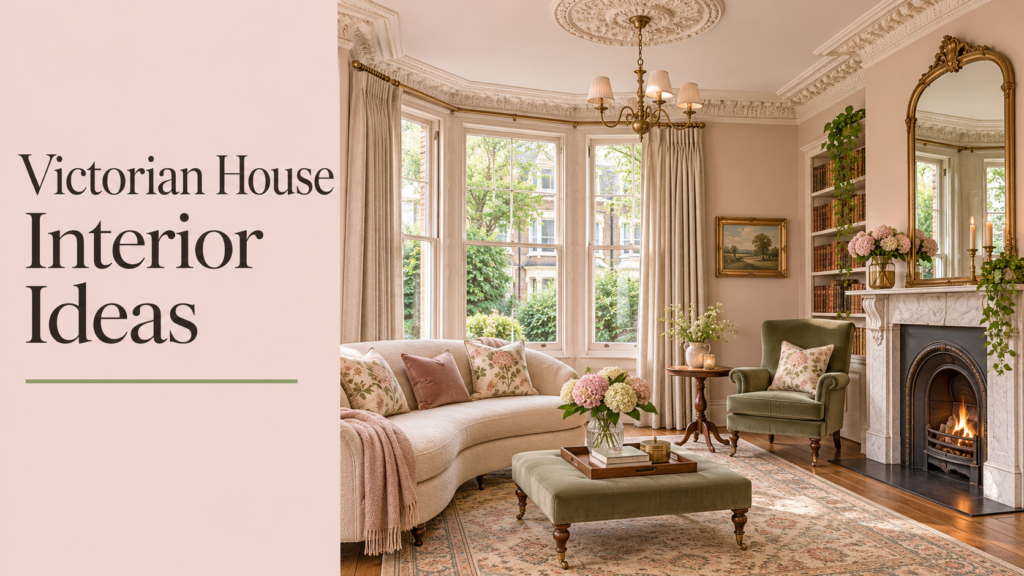
Victorian homes are a defining part of the British housing landscape. Rows of terraces, grand semi-detached villas and tall townhouses built between 1837 and 1901 still house millions of people. Their high ceilings, bay windows, ornate fireplaces, tiled hallways, cornicing and sash windows give them a warmth and character that buyers love. The challenge is making these homes work for modern life, with brighter rooms, open kitchens, home offices and better storage, without losing what makes them special.
This guide shares Victorian house interior ideas for every room. It covers the history and key features of Victorian design, colour palettes, wallpaper and patterns, flooring, lighting, furniture, layout ideas for terraces and semis, kitchen and bathroom inspiration, storage, modern Victorian style, budget tips and common mistakes.
Table of Contents
A Quick History of Victorian Interiors
Victorian interior design is a style that originated in the United Kingdom during the reign of Queen Victoria from 1837 to 1901. It was an era of rapid industrial change and a growing middle class keen to show off its homes.
Victorian interior design drew influences from a number of styles, from Rococo and Gothic to Renaissance and Romanesque. Mass production played a big role. In this period, between the 1830s and 1900s, mass production made home decor affordable and accessible for a wider market.
New Colours and Patterns
The Victorians gained access to bold new colours. For centuries, the colours that could be found in a home came from vegetable-based dyes that favoured muted earth-tones. The Victorian era saw the invention of aniline dyes that created bolder, jewel tones.
Wallpaper became a household staple. William Morris’s bird and animal print papers proved popular with homeowners in the Victorian era after wallpaper went into mass production in the 1840s.
The Arts and Crafts Reaction
Not everyone liked mass production. A reaction to this mass production was the Arts and Crafts movement, which was influenced by medieval architecture and led by designers such as William Morris.
Key Features of a Victorian Home
Victorian properties were characterised by a number of features including ornately patterned tiles, extravagant fireplaces, sash windows, sumptuous detailing, deep skirting boards and William Morris prints.
| Feature | Where You’ll Find It |
|---|---|
| Encaustic or geometric floor tiles | Hallways, porches, paths |
| Ornate fireplaces | Living rooms, bedrooms, dining rooms |
| Cornicing and ceiling roses | Reception rooms, hallways |
| Sash and bay windows | Front rooms, bedrooms |
| Deep skirting boards and picture rails | Throughout |
| Panelled doors | Throughout |
| Timber staircases and balustrades | Hallways |
| Stained glass | Front doors, windows |
| Original floorboards | Throughout |
| Ceiling heights | Especially generous on ground and first floors |
The Typical Victorian Terrace Layout
| Floor | Original Layout |
|---|---|
| Ground floor | Narrow hallway, front reception room, back reception room, small kitchen and scullery at the rear |
| First floor | Two or three bedrooms, often with a bathroom added later |
| Loft | Often converted in modern times |
| Outside | A narrow side return and long garden |
Victorian Colour Palette Ideas
Traditional Victorian Colours
| Colour | Mood | Best Rooms |
|---|---|---|
| Deep green | Rich, calming | Living rooms, studies, dining rooms |
| Burgundy and oxblood | Dramatic, cosy | Dining rooms, libraries |
| Navy and inky blue | Elegant, moody | Hallways, snugs, bedrooms |
| Mustard and ochre | Warm, golden | Accent walls, joinery |
| Plum and aubergine | Luxurious | Bedrooms, dining rooms |
| Terracotta and rust | Earthy | Kitchens, hallways |
| Warm stone and cream | Soft, light | Bedrooms, open-plan spaces |
Inky blues remain popular. One Victorian renovation used walls painted in Hague Blue, Farrow & Ball, with the fireplace painted white to make it pop against the walls.
How to Use Colour in a Victorian Home
- Use deeper colours in north-facing rooms: a dark colour can make a gloomy room feel cosy rather than cold
- Paint woodwork and walls the same colour: colour drenching suits high ceilings
- Highlight features with contrast: pick out cornicing, fireplaces or panelling
- Keep the hallway cohesive: the hall links every room, so choose a colour that works with each
- Use lighter colours on upper floors: bedrooms can feel more restful
Paint can highlight period features. One London design project used paint to show off a hallway’s features while sticking to a sophisticated and timeless colour scheme which brings the hall into the modern day.
Wallpaper and Pattern Ideas
Classic Victorian Patterns
- William Morris florals and botanicals
- Damask and flock wallpapers
- Trailing vines and birds
- Stripes and trellises
- Embossed Anaglypta and Lincrusta papers
Historically, walls were dark paneled with mahogany, walnut, or stained oak up to a dado rail, above which papers patterned with tangled lilies, brambles, or vines like those designed by William Morris were popular. Ceilings were treated too. Embossed paper was used on ceilings and friezes to counterbalance the busy wallpapers.
Modern Ways to Use Pattern
- One wallpapered wall behind a bed or sofa
- Wallpaper above a dado rail with painted panelling below
- Bold wallpaper in a downstairs cloakroom
- Wallpapered ceilings in hallways or dining rooms
- Patterned fabrics on curtains or cushions instead of walls
Restraint can look modern. A designer’s tip for modern Victorian rooms: A carved fireplace against a modern wall. A William Morris wallpaper used sparingly. An antique mirror layered into a contemporary sitting room.
Victorian Hallway Ideas
The hallway is the first impression of a Victorian home.
Keep the Original Tiles
Encaustic and geometric hallway tiles are treasured. One homeowner restored the original Victorian tiles of the hallway to their former glory. She added: ‘I don’t know how people can carpet over them!’
Hallway Design Tips
- Restore or reinstate tiled floors
- Paint lower walls or panelling in a durable, darker colour
- Add a striking stair runner
- Hang a statement pendant or lantern
- Use mirrors to bounce light in narrow halls
- Add hooks, a slim bench or shoe storage
- Restore stained glass in the front door
Should You Knock Through the Hallway?
Some owners remove the wall between the hall and living room, but this has trade-offs. One house tour notes that while some may opt to knock down the wall and create a larger, more open living area, this can often result in a long hallway that lacks functionality and privacy. In that home, a new stud wall was added, transforming the space into a home office.
Other homes benefit from opening up. In another project, the designer removed the awkward partition wall between the hallway and living room. Instantly, this made the space feel bigger, brighter, and more connected.
Victorian Living Room Ideas
Make the Fireplace the Focal Point
No Victorian home was complete without a fireplace, so this is something you should certainly add to your Victorian sitting room. Many original fireplaces are hidden. One owner discovered the orante fireplace hidden behind a piece of MDF.
Living Room Design Tips
- Restore the fireplace and use it as the focal point
- Build bespoke shelves or cupboards in the alcoves
- Hang curtains high and wide to emphasise ceiling height
- Layer rugs over floorboards
- Mix a modern sofa with antique side tables
- Use table lamps and wall lights for warm, layered lighting
- Display collections on the mantelpiece
Persian rugs suit the style well. To incorporate Victorian design into a more modern home, opt for layering large persian rugs over parquet or light wood flooring.
Use the Alcoves
Alcoves either side of the chimney breast are perfect for built-in storage. One designer created wardrobes in alcoves so that they disappear into the architecture, creating a seamless, built-in feel—like they were always meant to be there.
Double Reception Room Ideas
Many Victorian terraces have two reception rooms. Opening them up is a popular choice. One interior designer chose to knock through downstairs to create an inviting double reception room with a dual aspect.
Options for Two Reception Rooms
| Option | Benefit |
|---|---|
| Full knock-through | Light from both ends; flexible open space |
| Wide opening with double doors | Can be open or closed as needed |
| Keep separate rooms | A formal sitting room plus a snug, playroom or study |
| Broken-plan layout | Zones defined by partial walls, steps or furniture |
Houzz suggests a ‘broken-plan’ layout as a middle ground between open-plan and separate rooms.
Before knocking through: check whether the wall is load-bearing, get a structural engineer’s design, and check Building Regulations. If your home is listed, you will also need Listed Building Consent.
Victorian Kitchen Ideas
Typical Victorian Kitchen Challenges
The original kitchen was usually small and at the rear. Many owners extend into the side return or the garden.
Kitchen Layout Options
| Option | Description |
|---|---|
| Side return extension | Widens the kitchen and adds light with roof glazing |
| Rear extension | Creates a large kitchen-diner opening onto the garden |
| Wrap-around extension | Combines side and rear for maximum space |
| Galley kitchen | Works within the original footprint |
| Kitchen in the back reception room | Moves the kitchen into a larger, more central room |
Galley kitchens can still work well. My Bespoke Room’s design ideas include designing traditional galley kitchens in Victorian homes.
Kitchen Style Ideas
Traditional Victorian kitchen:
- Shaker or in-frame cabinets painted in heritage colours
- A Belfast sink with bridge taps
- A range cooker
- Butcher’s block or marble worktops
- Open shelving or a freestanding dresser
- Metro or Victorian-style tiles
Modern kitchen in a Victorian home:
Contrast between old and new can work beautifully. One homeowner said: ‘When we were choosing the new kitchen, I wanted a sleek, modern design.’ Another family describes a layered approach: ‘As you move through the house, it gets more contemporary. You have the Minton tiles in the hallway, the deep skirting boards in the front room, but then concrete, plywood and big steel windows at the back.’
Another Victorian villa has a very modern space, with handleless cabinetry and smooth matte surfaces, floor to ceiling Crittall doors and windows, and polished concrete flooring.
Victorian Dining Room Ideas
- Paint walls in a deep, dramatic colour
- Hang a chandelier or statement pendant
- Use a wooden or marble table with mixed vintage chairs
- Add a sideboard for storage and display
- Use wallpaper or panelling for interest
- Use candles and dimmers for evening atmosphere
Victorian Bedroom Ideas
- Keep or restore the bedroom fireplace as a decorative feature
- Use soft heritage colours or a William Morris-style wallpaper
- Choose an upholstered or iron bedstead
- Build wardrobes into alcoves
- Hang full-length curtains on sash windows
- Add panelling behind the bed
Bold colour also works in bedrooms. In one Victorian villa, the master bedroom was painted a teal colour, giving it a modern look.
Victorian Bathroom Ideas
Traditional Bathroom Features
- Roll-top or slipper bath
- Pedestal basin
- High-level or close-coupled cistern toilet
- Black-and-white or encaustic-style floor tiles
- Metro wall tiles
- Wood or tongue-and-groove panelling
- Cross-head taps in brass or nickel
One renovation used a roll-top bath and bathroom suite, Victorian Plumbing and even tin ceiling tiles for extra period detail.
Bathroom Tips
- Ensure good ventilation to prevent condensation
- Use underfloor heating to keep tiles warm
- Choose traditional-style towel radiators
- Consider a loft conversion to add an extra bathroom
Home Office and Snug Ideas
Victorian homes often have small rooms that suit modern uses:
| Space | New Use |
|---|---|
| Box room | Home office or nursery |
| Under-stairs space | Cloakroom, storage or tiny office |
| Front reception room | Snug, library or TV room |
| Loft | Bedroom suite or office |
| Cellar | Utility room, gym, wine store or den |
Snugs suit moody colours. In one Victorian home, a cosy snug is enveloped in a cocooning inky blue.
Flooring Ideas for Victorian Homes
| Flooring | Best For | Tips |
|---|---|---|
| Original floorboards | Living rooms, bedrooms | Sand gently, fill gaps, oil or stain |
| Encaustic and geometric tiles | Hallways, kitchens, bathrooms | Restore or source reclaimed |
| Parquet | Living rooms, hallways | Classic and durable |
| Natural stone or flagstone | Kitchens, extensions | Suits traditional styles |
| Polished concrete or microcement | Modern extensions | Creates contrast with older parts of the house |
| Carpet | Bedrooms, stairs | Use runners on stairs |
Wood floors suit the style well. To copy the Victorian look, parquet flooring or mid-toned polished floorboards are the way to go.
Lighting Ideas
- Ceiling roses with pendants or chandeliers: in reception rooms and hallways
- Wall lights: either side of fireplaces or mirrors
- Table and floor lamps: for warm, layered light
- Picture lights: for art and gallery walls
- Brass and aged-metal fittings: suit the period
- Traditional-style switches and sockets: in brass, nickel or black
Matching fittings throughout create harmony. In one renovated Victorian terrace, brass lighting, switches and handles feature throughout the house, too, creating a sense of continuity.
Ceiling roses are worth adding if they are missing. Ceiling roses are another way to add instant character and you can source both original and modern replica versions.
Furniture Ideas for Victorian Homes
Classic Victorian Pieces
- Chesterfield sofas
- Wingback and button-back chairs
- Mahogany or walnut sideboards
- Marble-topped washstands and side tables
- Victorian dining chairs
- Antique mirrors and overmantel mirrors
Mixing Old and New
You don’t have to furnish entirely with antiques:
- Pair a contemporary sofa with an antique coffee table
- Reupholster Victorian chairs in modern fabrics
- Use mid-century pieces for contrast
- Add modern art to traditional walls
One Victorian semi used a reclaimed mid-century wall unit for storage and as a focal point filled with trinkets and mementoes.
Storage Ideas for Victorian Homes
Victorian homes often lack built-in storage.
| Idea | Where |
|---|---|
| Alcove cupboards and shelves | Living rooms and bedrooms |
| Under-stairs storage | Hallways |
| Built-in wardrobes | Bedrooms, especially in alcoves |
| Window seats with storage | Bay windows |
| Loft and eaves storage | Top floors |
| Freestanding dressers and cabinets | Kitchens and dining rooms |
| Hallway benches and hooks | Entrances |
Modern Victorian Style: Getting the Balance Right
Modern Victorian style blends period character with contemporary comfort.
| Keep | Update |
|---|---|
| Fireplaces, cornicing, tiles, floorboards | Kitchens and bathrooms |
| Sash windows | Add secondary glazing or draught-proofing |
| Room proportions | Open up selectively for light and flow |
| Heritage colours | Use them in fresh combinations |
| Antique pieces | Mix with modern furniture and art |
The goal, as one design studio puts it, is to answer the question: How do you preserve all those beautiful period details while ensuring your home still feels fresh, functional, and simply you?
Victorian Style for Non-Victorian Homes
You can bring Victorian character into a modern flat or new-build:
- Add ceiling roses and cornicing
- Fit picture rails or panelling
- Use heritage paint colours
- Choose a Victorian-style fireplace surround
- Hang William Morris-style wallpaper
- Layer Persian rugs and antique furniture
- Use traditional lighting and switches
- Display collections on shelves and mantelpieces
Budget-Friendly Victorian Interior Ideas
- Paint: heritage colours transform rooms cheaply
- Strip back: remove carpets, boxing and paint to reveal original features
- Shop reclamation yards: for fireplaces, doors, tiles and radiators
- Buy antiques at auction: often cheaper than new quality furniture
- Reupholster existing furniture
- Add mouldings: ready-made cornicing and ceiling roses are affordable
- Use wallpaper on one wall or a cloakroom
- Restore rather than replace: repairing sash windows is often cheaper than replacing them
Relative Costs of Victorian Updates
| Update | Relative Cost |
|---|---|
| Painting rooms | Low |
| Wallpapering a feature wall | Low to moderate |
| Restoring floorboards | Low to moderate |
| Reinstating ceiling roses and cornicing | Low to moderate |
| Restoring a fireplace | Moderate |
| Restoring hallway tiles | Moderate |
| Sash window repair and draught-proofing | Moderate |
| Built-in alcove joinery | Moderate to high |
| Knock-through with steel beams | High |
| New kitchen | Moderate to high |
| Side return or rear extension | Very high |
| Loft conversion | High to very high |
Practical Considerations
Planning and Permissions
- Check if your home is listed or in a conservation area before major work
- Extensions, loft conversions and window changes may need planning permission
- Structural changes need Building Regulations approval
- Shared walls may need Party Wall agreements
Breathability
Victorian homes often have solid walls built with lime mortar. Use breathable paints and lime plaster where appropriate, and avoid sealing walls with impermeable materials that can trap damp.
Insurance
- Update your home insurance before major renovations
- Make sure the rebuild cost reflects traditional materials
- Update contents cover for valuable antiques and art
Home Value
Restored original features, well-designed kitchen extensions, extra bathrooms and loft conversions often add appeal and value to Victorian homes. Removing period features can reduce buyer interest.
Common Mistakes to Avoid
| Mistake | Better Approach |
|---|---|
| Covering original tiles with carpet | Restore and show them off |
| Ripping out fireplaces | Restore or reinstate |
| Replacing sash windows with uPVC | Repair and draught-proof |
| Removing cornicing and picture rails | Keep or reinstate |
| Over-opening the layout | Use broken-plan zones |
| Too much grey and white | Use warm heritage colours |
| Ignoring storage | Build into alcoves and eaves |
| Using non-breathable materials | Choose breathable paints and plasters |
| Making every room identical | Let each room have its own character |
Final Thoughts
Victorian homes combine generous proportions, beautiful craftsmanship and rich decorative history. Modern Victorian interiors celebrate original features such as tiled hallways, ornate fireplaces, cornicing, sash windows and floorboards, and update kitchens, bathrooms, layouts and storage for modern life. Heritage colours, William Morris-style patterns, layered lighting, Persian rugs and a mix of antique and contemporary furniture create warmth and personality. Whether you choose a full knock-through, a broken-plan layout, a sleek modern extension or a traditional galley kitchen, the best Victorian interiors respect the house’s history while reflecting how you live today.
Frequently Asked Questions
1. What colours suit a Victorian house?
Deep greens, inky blues, burgundy, mustard, plum and warm stone shades all suit Victorian interiors.
2. Should I knock through in a Victorian terrace?
It can add light and flow, but consider broken-plan layouts, check structural requirements and keep some separate spaces.
3. How do I make a Victorian house feel modern?
Keep original features and add modern kitchens, contemporary furniture, fresh colour combinations and layered lighting.