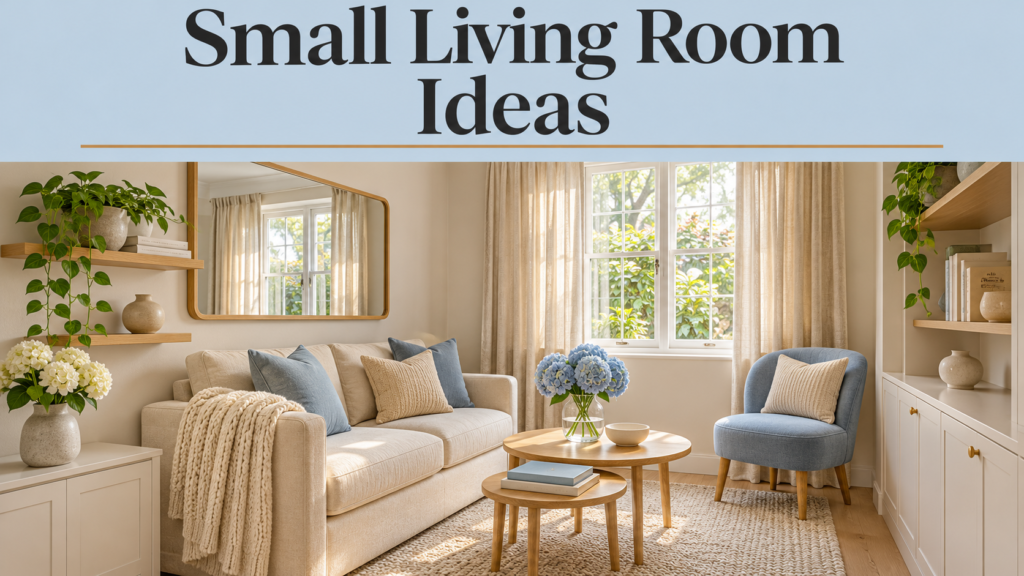
A small living room can feel like a challenge. It has to fit a sofa, TV, storage, a place for guests and sometimes a desk or a dining table, without feeling cramped. With the right layout, furniture scale, colour choices, lighting and storage, though, a compact living room can be one of the cosiest and most stylish rooms in your home.
This guide shares practical small living room ideas: planning a layout, choosing furniture of the right scale, colour schemes (light, dark and colour drenching), mirrors and lighting, storage, multi-functional pieces, window treatments, rugs, styling, ideas for rented homes and period properties, budget tips and common mistakes.
Table of Contents
Start With Function
Before buying anything, decide what your living room must do. Designers suggest that “Every inch counts in a small space, so every piece you bring in should earn its spot by adding storage, function, or flexibility.”
Questions to Ask Yourself
- How many people need seating every day, and how many occasionally?
- Is the TV the main focus, or conversation?
- Does the room also act as a home office, dining room, guest room or playroom?
- What needs to be stored: books, games, toys, work equipment?
- Where is the natural light, and where are doors, radiators and windows?
Small living rooms often do several jobs. A living room might be doubling up as a guest room, a home office, or a playroom, so will need to cater to all of these.
Plan the Layout First
Choose a Focal Point
When laying out a small living room you should look to create a main focal point and situate your furniture around that. Common focal points include a fireplace, TV wall, large window or a piece of art.
Test Before You Buy
A good way of doing this is to mark out large pieces of furniture on the floor using tape. This will allow you to ensure the room flows before putting furniture in place.
Small Living Room Layout Options
| Layout | Best For | Tips |
|---|---|---|
| Sofa facing TV | Everyday TV watching | Mount the TV on the wall to save floor space |
| Sofa and two chairs around a coffee table | Conversation and entertaining | Use small armchairs |
| L-shaped or corner sofa | Maximising seating | Choose a compact or modular design |
| Sofa against the longest wall | Narrow rooms | Keep walkways clear |
| Floating sofa with a console behind | Open-plan spaces | Defines zones without walls |
| Two small sofas facing each other | Conversation-focused rooms | Works well with a fireplace |
Designers often favour conversation-friendly layouts: ‘I always advise my clients to adopt a small living room layout that encourages conversations. By this, I mean a furniture arrangement which allows for maximum face-to-face time. This is especially practical if you love to entertain.’
Keep Walkways Clear
Leave clear walkways between doors and seating. Walkways of around 75–90 cm feel comfortable, though tighter gaps may work for secondary paths. Spacing still matters in small rooms. Finding the best furniture spacing is an important part of planning any room layout and should especially be considered when trying to make the most of space in a small living room.
Get the Furniture Scale Right
Scale is the most important factor in a small living room. Get the scale of your furniture right first, because nothing else fixes a room that’s stuffed with oversized pieces.
“Scale down your small living room furniture pieces to match your room’s size,” explains Artem. “Select furniture you can fit in the room, but doesn’t sacrifice style and comfort.”
Don’t Overfill the Room
‘You should also not put too much furniture in a small living room. Fewer, well-chosen pieces make a room feel calmer and more spacious.
Sometimes Bigger Is Better
Surprisingly, one large sofa can work better than several small pieces. Designers note that one of the most effective modern small living room ideas you’ll come across is using oversized furniture. A single generous sofa or sectional can feel calmer than lots of small chairs.
Sectionals can maximise seating. Livingetc’s designers suggest that you choose sectionals to maximize seating and offer comfort.
Furniture Tips for Small Living Rooms
| Tip | Why It Works |
|---|---|
| Choose leggy furniture | Showing more floor makes the room feel bigger |
| Avoid bulky arms and deep cushion backs | Saves valuable depth |
| Use nesting tables | Pull out when needed, tuck away when not |
| Pick round or oval coffee tables | Easier to move around |
| Choose glass or acrylic pieces | Feel visually lighter |
| Use wall-mounted shelves and TV | Frees floor space |
| Choose bespoke or made-to-measure pieces | Fit awkward alcoves and corners |
Leggy designs are a favourite tip: Choose leggy designs to expose more floor and avoid bulky pillow backs that eat depth.
Custom furniture can solve tricky layouts: ‘Choosing small living room furniture of the right scale and proportions are the key to designing small spaces, which is where customization comes in.
Multi-Functional Furniture
One of the most practical space-saving ideas for a small living room is to incorporate multi-functional furniture pieces.
| Piece | Extra Function |
|---|---|
| Sofa bed | Guest bed |
| Storage ottoman | Seating, footrest, storage |
| Lift-up or storage coffee table | Hidden storage or workspace |
| Nesting tables | Flexible surfaces |
| Drop-leaf or extendable table | Dining or work surface |
| Console behind the sofa | Desk, display or storage |
| Bench with storage | Seating plus storage |
| Wall-mounted fold-down desk | Home office that disappears |
Multi-functional pieces such as sofa beds or coffee tables with built-in storage are excellent space-savers.
Test the quality before buying. One designer warns: Not all multifunctional furniture is created equal. I’ve tested ottomans that look great but squeak or have lids too heavy to lift easily.
Colour Ideas for Small Living Rooms
Option 1: Light and Airy
A light palette creates a calm, airy atmosphere that instantly opens up your space without overwhelming it. Soft whites, warm neutrals, pale greys and pastels work well, especially in rooms with limited light.
Option 2: Dark and Cosy
Dark colours blur corners and create a cocooning feel. Designers increasingly recommend them for small rooms.
Option 3: Colour Drenching
Colour drenching is a popular choice for small rooms. For a modern twist, try colour drenching – painting your walls, ceilings, skirting boards, and even radiator in the same shade.
Designers love it with bold shades: ‘For small living rooms, color drenching, especially when using darker, braver colors, works best,’ says Justyna Korczynska of Crown Design Studio.
A helpful formula: Colour drenching formula: walls in main colour, ceiling 20% lighter, skirting in main colour or slightly darker.
Option 4: Tonal Schemes
Fewer colours make a room feel calmer. The more colours you introduce to your living room, the busier and more crowded the space will feel. To prevent this, match the main furniture items in the room to the colour of the walls.
Colour Scheme Comparison
| Approach | Effect | Best For |
|---|---|---|
| Light neutrals | Bright, airy, open | Rooms with good natural light |
| Dark colours | Cosy, dramatic, cocooning | North-facing rooms, evening use |
| Colour drenching | Seamless, larger-feeling space | Rooms with awkward architecture |
| Tonal (one colour family) | Calm, cohesive | Any small room |
| Neutral base with colour accents | Flexible and fresh | Renters and those who like change |
You can add colour without painting: If you want to keep your living room light but still want to add a bit of colour, you can introduce bright, bold tones using your cushions, curtains, rug and other soft furnishings.
Always Test Colours
Test paint samples on the actual walls of your small living room before committing. Small colour chip samples are completely unreliable guides to how a colour reads at full wall scale, particularly in rooms with limited natural light.
Use Mirrors to Create Space
Mirrors are one of the most effective small living room ideas you’ll come across. Placing large mirrors around the space will help reflect the ambient light and give the illusion that your room is bigger than it is.
Mirror Tips
- Go big: make sure you go large with your mirrors – there’s no room for small and dainty here.
- Place opposite a window: reflects light and views. One designer shared: In a 10′ x 12′ living room I renovated, one large mirror (36″–42″ wide) opposite the window transformed the depth of field.
- Use mirrored alcoves or panels: add depth to narrow rooms
- Lean a floor mirror: for an easy, renter-friendly option
- Avoid reflecting clutter: position mirrors to reflect light, art or plants
Lighting a Small Living Room
Layered lighting makes a small room feel larger and more welcoming.
| Layer | Examples |
|---|---|
| Ambient | Ceiling light, pendant or flush fitting |
| Task | Reading lamps, desk lamps |
| Accent | Picture lights, LED strips in shelves |
| Decorative | Table lamps, sculptural lights |
Lighting Tips
- Use several light sources instead of one bright ceiling light
- Choose wall lights or plug-in sconces to save floor and table space
- Add dimmer switches
- Use warm white bulbs for a cosy feel
- Light corners to push the walls visually outward
Smart Storage Ideas
Clutter is the biggest enemy of small living rooms. Designers often recommend a thorough de-clutter. A good, deep clean and declutter is not only good for the soul, it’s a great way to create the illusion of more space.
Storage Ideas
| Idea | Benefit |
|---|---|
| Floor-to-ceiling shelving | Uses vertical space |
| Built-in alcove cupboards | Hidden storage that blends with walls |
| Wall-mounted TV units | Frees floor space |
| Storage ottomans and benches | Seating plus storage |
| Baskets and boxes | Quick tidying for toys and blankets |
| Under-sofa storage | Uses hidden space |
| Shelves above doors and windows | Uses often-forgotten space |
| Closed cabinets in matching wall colour | Storage that visually disappears |
Tip: paint shelves and cupboards the same colour as the walls so they blend in.
Rugs and Flooring
- Choose a large rug that sits under the front legs of seating to make the room feel bigger
- Avoid tiny rugs that break up the floor
- Light wood or pale floors reflect light
- Run floorboards or patterns lengthways to elongate narrow rooms
Large rugs can blur boundaries. ‘Large rugs that flow under furniture will blur boundaries to give the illusion of a larger floor area.’
Window Treatments
- Hang curtain poles high and wide so windows look bigger
- Choose light, simple fabrics
- Use Roman blinds or shutters where curtains take too much space
- Avoid heavy, fussy window treatments that block light
Simple treatments help. Designers recommend options that include white ceilings, light wood flooring and not having fussy window treatments.
Styling and Decor Tips
Keep Accessories Edited
- Choose a few larger accessories rather than many small ones
- Group items in odd numbers
- Use one large artwork instead of many small frames
- Rotate decor seasonally
Add Texture
Texture adds warmth without clutter. Mix boucle, linen, wool, wood, rattan and ceramics.
Use Plants
Plants bring life to small rooms. Trailing plants on shelves or a single tall plant in a corner work well without taking much floor space.
Make It Cosy, Not Just Bigger
Not every small room needs to look larger. Some designers argue the opposite. One designer writes that the common advice of light colours, mirrors and small furniture addresses the wrong problem. The goal of a small living room is not to make it appear large.
Instead, aim for comfort:
- Deep, comfortable seating
- Soft lighting and lamps
- Layered textiles such as throws and cushions
- Warm, rich colours
- Personal objects and books
Small Living Room Ideas for Specific Situations
Rented Homes
- Use removable wallpaper or peel-and-stick decals
- Lean large mirrors instead of hanging them
- Add colour with textiles, rugs and art
- Use freestanding storage
- Use plug-in wall lights instead of hardwired fittings
- Check your tenancy agreement before painting
Period Homes
- Use alcoves for built-in shelving or cupboards
- Highlight the fireplace as a focal point
- Paint mouldings and walls the same colour for a seamless look
- Keep window shutters and avoid heavy curtains
Open-Plan Small Spaces
- Use rugs to define the living zone
- Place a console behind the sofa as a divider
- Use open shelving as a room divider
- Keep a consistent colour palette across zones
Living Room With a Home Office
- A fold-down wall desk
- A console table that doubles as a desk
- Storage that hides work equipment at the end of the day
- A comfortable chair that works for both relaxing and working
Budget-Friendly Small Living Room Ideas
- Declutter first: it’s free and makes the biggest difference
- Rearrange furniture: try new layouts before buying anything
- Paint: a fresh colour scheme transforms a room
- Add a large mirror: affordable and effective
- Swap textiles: new cushion covers, throws and curtains
- Use second-hand furniture: quality pieces at lower prices
- Add plants: inexpensive and refreshing
- Improve lighting: add lamps and warm bulbs
Relative Costs of Small Living Room Updates
| Update | Relative Cost |
|---|---|
| Decluttering and rearranging | Free |
| New cushions, throws and rugs | Low |
| Large mirror | Low to moderate |
| Painting the room | Low to moderate |
| New lamps and lighting | Low to moderate |
| Storage furniture | Moderate |
| New compact sofa | Moderate to high |
| Built-in alcove joinery | Moderate to high |
| Bespoke furniture | High |
Common Small Living Room Mistakes
| Mistake | Better Approach |
|---|---|
| Too much furniture | Choose fewer, well-scaled pieces |
| Pushing all furniture against the walls | Float pieces where it improves flow |
| Tiny rugs | Use a large rug under the front legs of seating |
| Too many small accessories | Choose fewer, bigger pieces |
| One harsh ceiling light | Layer lighting with lamps |
| Heavy curtains blocking light | Use lighter fabrics and hang high |
| Ignoring vertical space | Use tall shelving and wall storage |
| Bulky furniture with no legs | Choose leggy designs |
| Too many colours | Keep a cohesive palette |
Final Thoughts
A small living room can be stylish, comfortable and practical with careful planning. Start with function and a clear focal point, test your layout before buying, and choose furniture of the right scale, ideally leggy, multi-functional and sometimes surprisingly generous. Light colours open up a space, while dark colours and colour drenching create cosy, seamless rooms. Large mirrors, layered lighting, big rugs, simple window treatments and smart storage all help. Most importantly, keep clutter under control and fill the room with pieces you love, because a small living room doesn’t have to feel big to feel wonderful.
Frequently Asked Questions
1. What colour makes a small living room look bigger?
Light neutrals open up a room, but dark colours and colour drenching can also make walls recede and feel cosy.
2. What sofa is best for a small living room?
A compact sofa with slim arms and raised legs, or one well-scaled sectional for maximum seating.
3. Where should I put a mirror in a small living room?
Place a large mirror opposite a window to reflect light and create a sense of depth.