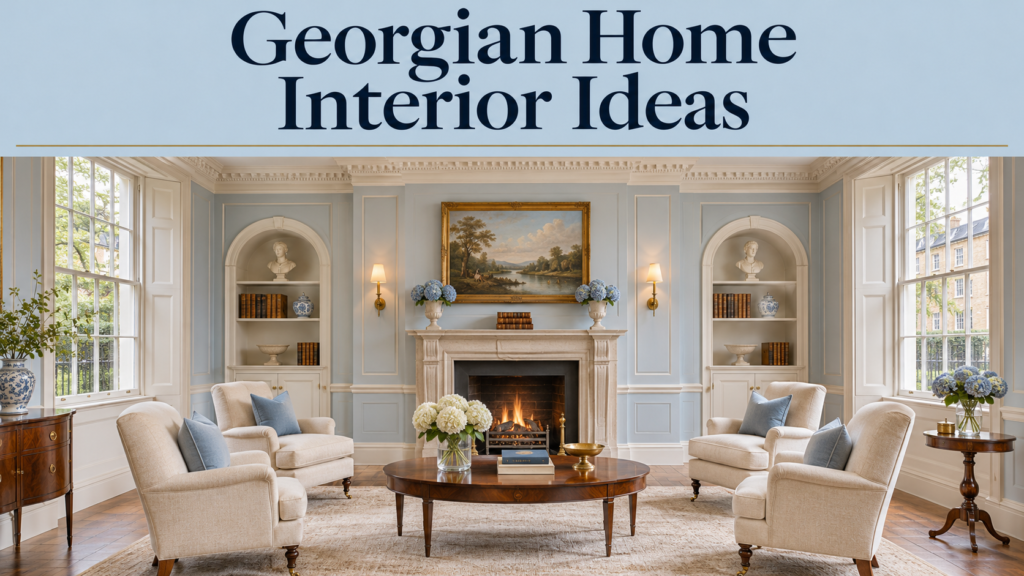
Georgian homes are often described as the most elegant houses in Britain. Built roughly between 1714 and 1830, under Kings George I to George IV, they are admired for their perfect proportions, tall sash windows, balanced facades, graceful staircases and refined plasterwork. From grand London and Bath townhouses to Edinburgh’s New Town and modest country rectories, Georgian interiors have a calm order that still feels fresh today.
This guide shares Georgian home interior ideas for every room. It covers Georgian design history and principles, key features, authentic and modern colour palettes, panelling and shutters, flooring, lighting, furniture, room-by-room ideas, how to modernise sensitively, Georgian style in new homes, budget tips, listed building considerations and common mistakes.
Table of Contents
A Brief History of Georgian Design
Technically, Georgian is not a style but an era – the period within which we saw the development of architecture and interior design from a number of key designers including Chippendale, Adams, and Hepplewhite. The Georgian era marked a high point of house design in Britain.
Georgian design was shaped by classical architecture. The Georgian style in Britain and other English-speaking countries had a much more classical feel and was influenced by ancient Greek and Roman architecture. It was characterized by harmony, symmetry, clean lines and delicate furniture.
Major Influences
| Influence | Key Figures | Impact |
|---|---|---|
| Palladianism (early Georgian) | Inspired by Andrea Palladio and Inigo Jones | Strict symmetry and classical proportions |
| Neo-classicism (mid-late Georgian) | Robert Adam, James Wyatt, William Chambers | Delicate plasterwork, refined colour schemes |
| Furniture design | Chippendale, Hepplewhite, Sheraton | Elegant, finely crafted furniture |
| Regency (late Georgian) | John Nash, Sir John Soane | Lighter colours, stucco, more ornament |
Palladianism spread widely. In Bath, for example, architects like John Wood came to the city to build new houses in the fashionable building style of Palladian architecture.
As the era went on, decoration lightened. As the century progressed, the style became lighter and lighter in terms of colours and decoration and eventually became Regency style.
Core Principles of Georgian Interiors
1. Symmetry
At the heart of Georgian design is symmetry, both inside and out. Traditional Georgian homes are characterised by balanced facades, evenly spaced windows, and central doorways. Inside, rooms are often arranged in a grid-like layout.
Mylands explains why this matters: Georgian interiors have an order and symmetry to it. That makes the exterior and interior feel balanced, harmonious and in proportion. In turn, that gives an air of peace.
2. Proportion
Rooms followed classical ratios, with tall ceilings and carefully sized windows. In townhouses, window height varied by floor: The tallest sash windows in Georgian townhouses would often be on the first floors, while the shortest Georgian sash windows would be on the top floor.
3. Restraint
Compared with the busy Victorian era, Georgian interiors were calmer. Unlike the Victorian era which celebrated an abundance of furniture, Georgian interior design was slightly simpler, letting the harmonious architectural details shine.
4. Classical Detailing
The interiors had harmonious proportions, muted colors, and Roman-derived stucco ornamentation.
Key Features of a Georgian Home
| Feature | Description |
|---|---|
| Sash windows with internal shutters | Multi-paned sashes; shutters fold into window reveals |
| Fanlights | Semi-circular glazing above front doors |
| Panelled walls | Timber panelling, especially in earlier Georgian homes |
| Cornicing and ceiling decoration | Classical plasterwork |
| Chimneypieces | Marble, stone or carved timber fireplaces |
| Grand staircases | Elegant balustrades and handrails |
| Stone or marble floors | Common in halls |
| Dado rails | Divide walls into proportions |
| Six-panel doors | Classic Georgian door design |
| High ceilings | Especially on principal floors |
Key design features of Georgian homes included intricate ceiling moulds, sash windows and shutters, classical figures, urns and stone/marble floors. Shutters were standard: All the windows would normally have shutters.
Georgian Colour Palette Ideas
Authentic Georgian Colours
Georgian colour was based on available pigments and their cost. Historic paint research shows that stone tones dominated: natural stone and stony colours predominate even in high status interiors.
Stone colours were especially common in halls and stairs. Building conservation research notes: Stone or common colours are used in the communal spaces like the hall and stair and richer colours, some with pattern, adorn the family rooms.
Economy also played a role. It could take up to five coats to achieve a solid colour and so lighter colours remained the choice for economy.
Bold Georgian Colours
Georgians weren’t always restrained. Mylands notes that Georgian houses have the proportions that can work well with bolder, more daring colours too. In fact, wealthy Georgians liked to shock and show off with their colour schemes. Rich burgundy, lush green and pretty pinks were all popular.
Robert Adam and his contemporaries introduced more refined colour. By the reign of George III the scene was set for the great neo-classical architects, Chambers, Wyatt and Adam, to introduce intricate and subtly contrasting areas of colour into wall and ceiling decoration.
Georgian Colours for Modern Homes
| Colour Family | Mood | Best Rooms |
|---|---|---|
| Stone and drab colours | Calm, authentic | Halls, staircases, landings |
| Sage and green-grey | Soft, timeless | Living rooms, bedrooms |
| Pale blue and duck egg | Fresh, airy | Bedrooms, drawing rooms |
| Muted pinks | Elegant, warm | Drawing rooms, bedrooms |
| Rich green | Grand, dramatic | Libraries, dining rooms |
| Burgundy and red | Bold, formal | Dining rooms |
| Warm whites and creams | Light, classical | Ceilings, cornices, joinery |
A Bath designer recommends that soft colours like sage greens, green toned greys, pale taupes, stone, natural beiges, sophisticated muted pinks and pale blues are timeless and work well in period homes, looking fresh and modern paired with contemporary fabrics and wallpaper.
Mylands also suggests calmer neutrals like Egyptian Grey™ No.154 and Honest John™ No.58 work well in modern-day Georgian homes.
Colour Tips for Georgian Rooms
- Use stone colours in halls and stairs: authentic and calm
- Choose richer colours for principal rooms: drawing and dining rooms can take drama
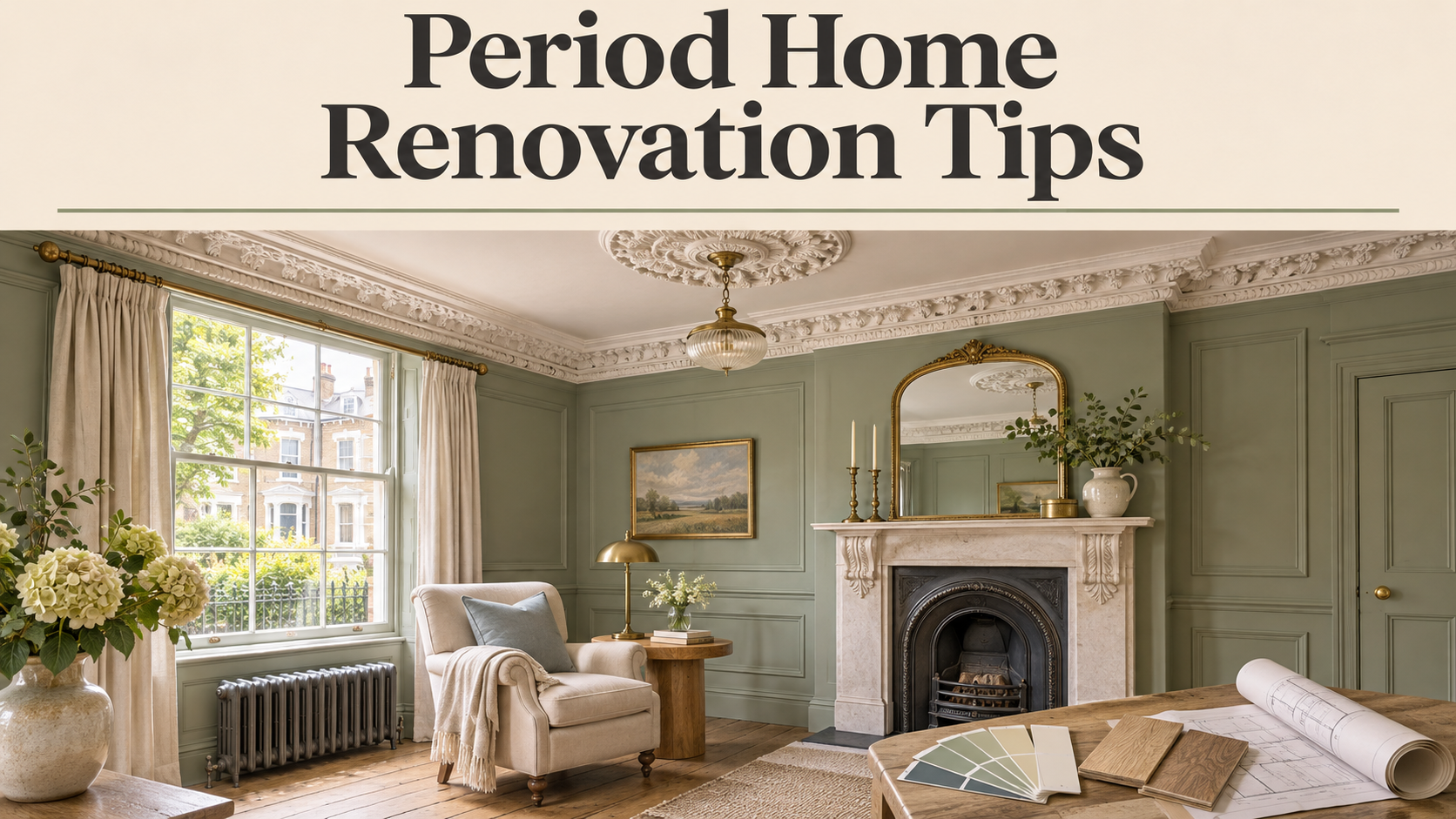
- Paint mouldings the wall colour for a modern look: in one Bath townhouse, high ceilings and decorative mouldings painted in a single colour to give them a more modern sensibility.
- Go bold in large rooms: big Georgian rooms can easily absorb strong colours
- Highlight plasterwork subtly: use a slightly different tone on cornices and ceilings
Bold colour can work brilliantly. In one Edinburgh New Town townhouse, the drawing room’s vast proportions easily absorb the bold hue, and even feels quite pared-back.
Panelling, Shutters and Wall Treatments
Panelling
Panelling defines many Georgian rooms, especially earlier ones. Over time, wallpaper became more common. It was during the Georgian era that wallpaper replaced wood paneling as the covering for interior walls.
Panelling ideas:
- Restore original panelling and paint it in heritage colours
- Add new panelling in plain, well-proportioned Georgian styles
- Use full-height panelling in halls and libraries
- Use dado-height panelling in dining rooms
Mouldings help reinforce symmetry: Mouldings provide symmetry and Georgian is all about symmetry so maintain that angular feel by using cornices, mouldings or panelling.
Shutters
Internal shutters are one of the most practical Georgian features:
- They reduce heat loss at night
- They provide privacy
- They control light
- They keep the original look of the windows
Restore working shutters rather than replacing them with blinds. Where shutters are missing, bespoke reproductions can be made.
Wallpaper
- Hand-printed Georgian-style papers with stripes, damasks or Chinoiserie
- Scenic papers in dining rooms
- Subtle textured or stone-effect papers in halls
Flooring Ideas for Georgian Homes
| Flooring | Where | Tips |
|---|---|---|
| Stone flags or marble | Halls, entrances | Classic Georgian look; restore or source reclaimed |
| Wide timber boards | Principal rooms, bedrooms | Sand gently; oil, wax or lime-wash |
| Geometric tiles | Halls, kitchens | Use diamond, hexagon or square patterns |
| Herringbone or chevron | Living rooms, kitchens | A modern take on traditional parquet |
| Rugs | Throughout | Large rugs ground furniture groupings |
Patterns echoed symmetry. Geometric pattern floor tiles motifs, such as diamonds, hexagons, and repeating square patterns, were often used to mirror the overall symmetry of the interior.
Rugs suit the style well too. Large area rugs are excellent choices for this style.
Lighting Ideas
Georgian homes were originally lit by candles and oil lamps, so modern lighting needs careful planning:
- Chandeliers: in halls, drawing rooms and dining rooms
- Wall sconces: placed symmetrically either side of fireplaces and mirrors
- Table lamps: for warm, layered light
- Lanterns: in halls and stairwells
- Picture lights: for art
- Discreet modern lighting: avoid too many downlights in decorative ceilings
Tip: keep lighting symmetrical, for example matching lamps on console tables or pairs of wall lights.
Furniture Ideas for Georgian Interiors
Classic Georgian Furniture
Georgian furniture is light, elegant and well proportioned. The furniture tended to feature carved wood with luxurious upholstery, such as velvet or damask. Cabriole legs and claw feet are common features of furniture from this era.
| Piece | Style |
|---|---|
| Chippendale chairs | Carved backs and cabriole legs |
| Hepplewhite chairs | Shield-shaped backs |
| Sheraton furniture | Slender, straight lines |
| Mahogany dining tables | Pedestal or drop-leaf designs |
| Bureaux and secretaires | Elegant writing furniture |
| Console tables with mirrors | Placed between windows |
| Bookcases | Glazed, in libraries and studies |
| Four-poster beds | In principal bedrooms |
Modern Furniture in Georgian Rooms
Georgian clean lines suit modern design. While Georgian design is rooted in tradition, its clean lines and symmetry naturally complement modern minimalism. To achieve this fusion, focus on quality over quantity.
Ideas:
- Pair antique chairs with a modern dining table
- Add a contemporary sofa against panelled walls
- Use mid-century or modern art in classical rooms
- Upcycle old pieces with paint or new upholstery
Mylands suggests mixing heritage and personal style, adding that upcycling furniture can be a great DIY project.
Room-by-Room Georgian Interior Ideas
Entrance Hall and Staircase
- Restore stone or marble floors
- Paint walls in stone or drab colours
- Highlight the staircase with a runner and restored balustrade
- Hang a lantern or chandelier
- Place a console table with symmetrical lamps or vases
- Hang a large mirror to reflect light
One Georgian hallway uses Mylands Honest John on walls with Messel on woodwork.
Drawing Room / Living Room
The drawing room was the most formal Georgian room, often on the first floor in townhouses.
- Arrange furniture symmetrically around the fireplace
- Use a pair of sofas or armchairs facing each other
- Restore shutters and hang curtains with pelmets
- Use soft blues, pinks, greens or stone colours
- Add matching wall lights and a central chandelier
- Display art in balanced groupings
In a family home, comfort matters: In a family home, a cosy living room style can be appealing.
Dining Room
- Keep symmetry by ensuring you have the same number of chairs either side of the dining table.
- Choose rich colours such as deep green or burgundy
- Use a mahogany table and Georgian-style chairs
- Add a sideboard for display
- Hang a chandelier over the table
- Use scenic wallpaper or panelling
Library or Study
- Built-in bookcases with classical detailing
- Deep greens, reds or browns
- Leather armchairs and a writing desk
- Brass picture lights and desk lamps
One project aimed for the look of a Spitalfields townhouse with a dash of gentlemen’s club, using earthy green all over, including on the window frame.
Kitchen
Georgian kitchens were originally in basements and service areas. Modern Georgian kitchens should feel connected to the house’s character.
- Shaker or in-frame cabinets in heritage colours
- Natural stone or wooden worktops
- A range cooker or traditional-style appliances
- Freestanding dressers and larders
- Stone, tile or timber flooring
- Hidden storage to keep surfaces calm
Avoid kitchens that clash with the house. In one Clerkenwell townhouse, the existing kitchen felt overly modern and disconnected from the Georgian fabric of the house.
Hidden storage suits the Georgian approach. One townhouse kitchen was described as a contemporary update on some of the clever ideas the swan-like Georgians had, making life look serene and calm on the surface, so that the busy workings of the house, the day-to-day activities, could be hidden away.
Bedrooms
- Soft pale colours or floral wallpapers
- Four-poster or upholstered beds
- Shutters and full curtains
- Symmetrical bedside tables and lamps
- Built-in or antique wardrobes
Country Georgian homes suit softer styles: In Georgian country houses and cottages, cottagecore style works well. Floral patterns, natural textiles and pretty ornaments complete the look.
Bathrooms
Georgian-style bathrooms can feel luxurious. Savills notes that Georgian bathrooms often featured the symmetry you’d expect, with neat panelling on the walls, and standalone baths and his and hers sinks.
- Freestanding bath centred on a window or wall
- Double basins placed symmetrically
- Panelled walls painted in soft colours
- Marble or stone flooring
- Classic brass or nickel taps
Georgian Townhouse vs Country House Interiors
| Feature | Townhouse | Country House |
|---|---|---|
| Layout | Tall and narrow over several floors | Wider, often with more rooms on each floor |
| Style | Formal, urban elegance | Relaxed, rural elegance |
| Colours | Sophisticated, sometimes bold | Softer, nature-inspired |
| Furniture | Refined, formal | Comfortable, mixed |
| Kitchens | Often in the basement or ground floor | Large country kitchens |
How to Modernise a Georgian Home Sensitively
What to Keep
- Room proportions and symmetry
- Sash windows and shutters
- Fireplaces and chimneypieces
- Cornicing, ceiling decoration and panelling
- Staircases and balustrades
- Original floors
What to Update
- Kitchens and bathrooms
- Heating, plumbing and electrics
- Lighting schemes
- Furniture, art and fabrics
- Storage solutions
Mylands sums up modern Georgian style: Keep these home interior principles, but incorporate current design elements. That could be modern artwork, vibrant fabrics, contemporary furniture or colour schemes.
Basement and Lower Ground Floors
Many Georgian townhouses have basements that can become kitchens, family rooms or guest suites. Basement work needs careful damp management, structural advice and usually Building Regulations approval.
Listed Georgian Homes: What You Need to Know
Many Georgian homes are listed buildings. Before making changes:
- Check listing status with your local council or the national heritage list
- Apply for Listed Building Consent for alterations affecting character, inside or outside
- Speak to the conservation officer before planning major work
- Use breathable materials such as lime plaster and breathable paints
- Repair rather than replace original features
Unauthorised works to listed buildings are a criminal offence, so always get consent first.
Bringing Georgian Style Into Modern Homes
You can add Georgian elegance to newer homes:
- Create symmetry: arrange furniture, lamps and art in pairs
- Add mouldings: cornicing, ceiling roses, dado rails and panelling
- Use classical colours: stone, sage, duck egg and muted pinks
- Choose Georgian-style doors and fireplaces
- Install shutters: for a Georgian window look
- Use patterned floors: herringbone, chevron or geometric tiles
As one guide suggests, installing crown moulding or panelling can instantly elevate a room and create that Georgian feel.
Budget-Friendly Georgian Interior Ideas
- Paint: heritage colours instantly add elegance
- Restore rather than replace: shutters, floors and doors
- Buy antiques at auction: Georgian-style furniture is often affordable
- Add pairs: matching lamps, cushions and vases create symmetry cheaply
- Fit off-the-shelf mouldings: cornicing and dado rails
- Use large mirrors: reflect light and add grandeur
- Upcycle furniture: paint or reupholster old pieces
Relative Costs of Georgian Updates
| Update | Relative Cost |
|---|---|
| Painting rooms in heritage colours | Low to moderate |
| Adding dado rails and simple mouldings | Low |
| Restoring floorboards | Low to moderate |
| Repairing shutters | Moderate |
| Sash window restoration | Moderate |
| Restoring plasterwork and cornicing | Moderate to high |
| New panelling | Moderate to high |
| Restoring stone floors | Moderate to high |
| Bespoke joinery and bookcases | High |
| New kitchen | Moderate to high |
| Basement conversion | Very high |
Insurance and Value Considerations
Home Insurance
- Rebuild costs for Georgian homes are often high because of specialist materials and craftsmanship
- Listed Georgian homes may need specialist insurance
- Update contents cover for antiques and art
- Tell your insurer before major renovations
Home Value
Georgian homes are highly desirable. Sensitive restoration of original features, well-designed kitchens and bathrooms, and respect for proportions usually support value. One guide notes that Georgian features can enhance both the character and value of your property.
Common Mistakes to Avoid
| Mistake | Better Approach |
|---|---|
| Breaking symmetry with awkward furniture | Arrange in balanced pairs |
| Removing shutters or sash windows | Restore and draught-proof |
| Over-cluttering rooms | Keep Georgian restraint |
| Too many downlights in decorative ceilings | Use lamps, sconces and chandeliers |
| Ultra-modern kitchens that clash | Choose styles that suit the house |
| Using non-breathable paints and plasters | Use breathable materials |
| Ignoring listed building rules | Always seek consent |
| Painting everything brilliant white | Use stone, warm whites and heritage colours |
Final Thoughts
Georgian home interiors are defined by symmetry, proportion, restraint and refined classical detail. Tall sash windows with shutters, panelled walls, cornicing, elegant fireplaces, stone halls and graceful staircases create calm, beautifully balanced rooms. Authentic Georgian colours range from stone and drab tones in halls to sage, duck egg and muted pinks, and to bold greens, burgundies and pinks in principal rooms. Modern Georgian style keeps the architecture and proportions intact while adding contemporary art, comfortable furniture, sensitive kitchens and bathrooms, and good lighting. Whether you own a listed townhouse or want Georgian elegance in a newer home, focus on balance, quality and respect for classical design.
Frequently Asked Questions
1. What are the main features of Georgian interiors?
Symmetry, tall sash windows with shutters, panelling, cornicing, classical fireplaces and stone or timber floors.
2. What colours suit a Georgian home?
Stone colours, sage, duck egg blue, muted pinks and warm whites, with richer greens and burgundies in formal rooms.
3. How is Georgian style different from Victorian style?
Georgian design is calmer and more symmetrical, while Victorian interiors are busier, more ornate and more richly patterned.