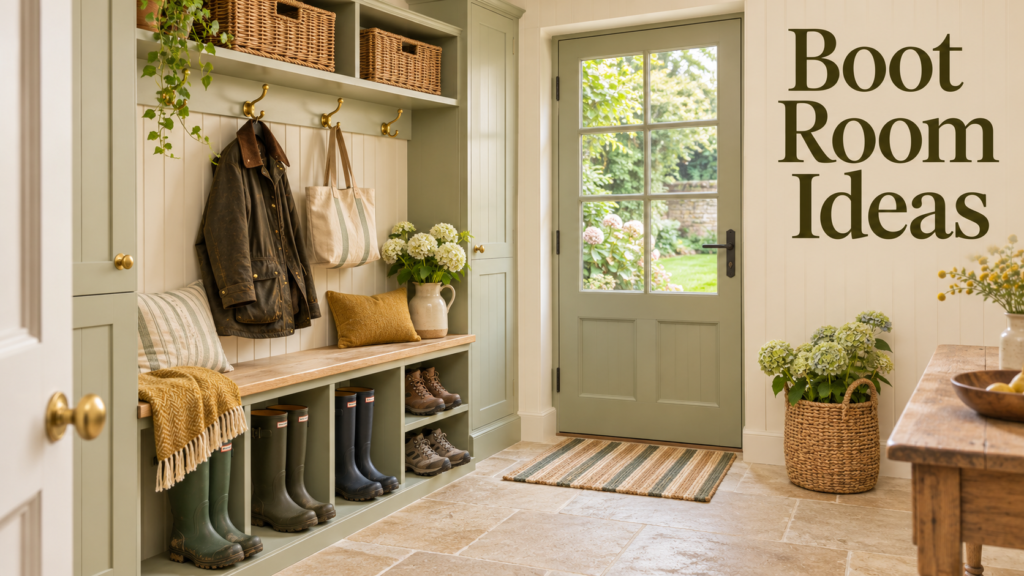
The boot room has become one of the most wanted spaces in British homes. With wet weather, muddy walks, dogs, children’s sports kit and bikes, a dedicated spot to drop coats, boots and bags keeps the rest of the house cleaner and calmer. A boot room doesn’t have to be a large room either: it can be a converted utility room, a section of hallway, an under-stairs cupboard, a porch, part of a garage or a new side extension.
This guide covers boot room ideas for UK homes: where to put one, layouts, storage, benches, coat hooks, boot and shoe storage, drying cupboards, sinks and dog wash stations, flooring, wall finishes, ventilation and heating, small-space ideas and UK costs.
Table of Contents
What Is a Boot Room?
A boot room is a transitional space between outdoors and indoors, usually near a back or side door, where muddy footwear, wet coats and outdoor gear are stored and cleaned.
Homebuilding notes that given the UK climate, it’s likely water and mud will be a regular visitor to your boot room. It adds that a boot room is a key feature in helping to keep the rest of your home clean, as it is where you can wash muddy hands, rinse down your dog or even prep veg from the garden.
What Do You Need Your Boot Room to Do?
| Function | Features Needed |
|---|---|
| Coat and shoe storage | Hooks, shoe racks, cubbies |
| Dog care | Dog wash station, towel storage, bed, feeding area |
| Laundry | Washing machine, dryer, worktop |
| Drying wet gear | Heated drying cupboard, heated rails |
| Bike and sports kit storage | Wall racks, tall cupboards |
| Gardening | Sink, potting bench, tool storage |
| Main family entrance | Bench, mirror, key and post station |
| Charging station | Sockets for phones, e-bikes, tools |
Homebuilding suggests deciding early: Do you want to use it solely to store coats and footwear, or are you planning on using it as a space for your laundry room ideas, to wash off pets or even to act like the main entrance to your home?
Where to Put a Boot Room
| Location | Pros | Cons |
|---|---|---|
| Utility room | Plumbing already there; combines laundry | Can get crowded |
| Back or side entrance | Natural route from garden | May need building work |
| Hallway | No building work needed | Limited space, on show |
| Under the stairs | Uses dead space | Small, may lack ventilation |
| Porch | Keeps mud outside the house | Small; may be cold |
| Garage conversion | Lots of space | Building work and costs |
| Side extension | Purpose-built | Most expensive |
| Kitchen corner | Convenient | Mud near food prep |
Combining a Boot Room and Utility Room
This is the most common solution in UK homes because plumbing is already there. Which? lists a utility room’s possible extra uses as including dog room, bike storage and coat and boot room.
BookaBuilder suggests a practical layout for combined spaces:
- Entry zone with boot storage and coat hooks
- Wet zone with a sink and possibly a pet wash or floor drain
- Laundry zone with machines and worktop
- Drying zone with rails or an airing system
It adds a useful trade tip: keep plumbing and electrics on one side where possible to reduce cost. Use the opposing wall for hooks, shallow shelving and boot storage.
Hallway Boot Rooms
If you can’t create a separate room, use your hallway. Homebuilding notes that if new boot room ideas aren’t possible, such as when renovating a Victorian house, turning your hallway into a bespoke boot room area instead can be the next best thing.
Boot Room Storage Ideas
Coat Storage
| Option | Best For |
|---|---|
| Coat hooks | Everyday coats and bags |
| Peg rails | Cottage and country style |
| Tall cupboards with hanging rails | Hiding coats away |
| Open lockers per person | Family organisation |
| Double-height hooks | Adults and children |
| Hooks below a drying rail | Wet gear |
Hooks are a simple, budget-friendly option. Which? lists hooks instead of a coat rack as a utility room money-saving idea.
Boot and Shoe Storage
- Pull-out boot drawers
- Slatted shelves so mud can drop through
- Boot trays under benches
- Wellington racks or upside-down boot pegs
- Shoe cubbies under seating
- Tall cupboards for long boots
Locker-Style Storage
Individual lockers give each family member their own space. Hampstead Renovations describes locker-style storage as individual compartments for each family member with hooks, shelves, and cubbies in each, and notes this teaches children organisation and can be labelled with names.
Bench Seating
A bench is essential for putting on and taking off boots.
- Storage benches with lift-up seats
- Benches with cubbies below
- Built-in window seats
- Upholstered seat pads in wipeable fabric
Other Storage Ideas
| Storage | Use |
|---|---|
| Baskets | Hats, gloves, scarves |
| Overhead shelves | Seasonal items |
| Key hooks and post holders | Everyday essentials |
| Wall-mounted bike racks | Bikes |
| Tall broom cupboards | Vacuums, mops |
| Umbrella stands | Wet umbrellas |
| Sports kit bins | Balls, rackets, kit bags |
| Lockable cupboards | Cleaning products |
Howdens suggests that you make boot room features work twice as hard by adding cupboards below a cleaning station. Besides offering a place to wash, this boot room storage idea doubles up as a store for household supplies.
Drying Wet Coats and Boots
Drying wet gear is one of the most useful boot room features.
| Drying Option | Benefits |
|---|---|
| Heated drying cupboard | Dries coats and boots out of sight |
| Heated towel rails | Dries gloves, hats and towels |
| Boot dryers | Dries footwear quickly |
| Ceiling clothes airer | Saves floor space |
| Radiators with shelves | Dries boots and gloves |
| Dehumidifier | Reduces damp |
Hampstead Renovations describes a drying cupboard as a heated cupboard with vents for wet coats, boots, sports equipment, with a small heater or heated rail inside, costing around £300-£800.
Tip: don’t place drying rails over walkways. BookaBuilder advises: Avoid placing drying rails directly over the walkway, as this blocks access.
Sinks and Dog Wash Stations
Boot Room Sinks
A sink is useful for washing hands, muddy boots, garden produce and dog bowls.
- Butler or Belfast sinks
- Deep utility sinks
- Hose taps or pull-out spray taps
- Outdoor-style taps for rinsing boots
Dog Wash Stations
With so many UK households owning pets, dog wash stations are increasingly popular. Neville Johnson notes that more than 50% of UK homes own a dog or cat and, as any of those households will undoubtedly attest, pet ownership brings its own special storage and cleaning requirements!
Dog Wash Features
- Raised shower tray (easier on your back)
- Handheld shower spray
- Warm water supply
- Non-slip base
- Tiled walls
- Proper drainage
- Towel storage and hooks
- Lead hooks
- Dog bed area nearby
Hampstead Renovations installs dog showers with raised bases, handheld sprayers, warm water, proper drainage and towel storage.
Floor Drains
In larger boot rooms, a floor drain makes cleaning much easier. Real Homes notes that in a larger boot room, a drain could be incorporated in the centre so that dirt can be swished away. Got a dog? It’s the perfect place for a dog shower, too.
Dog-Friendly Extras
- Built-in dog beds in cabinetry
- Feeding stations in low drawers
- Lead and harness hooks
- Treat and food storage
- Dog towel drawers
Hammonds suggests that a low-level shelf can serve as a feeding station, keeping bowls neatly tucked away when not in use.
Boot Room Flooring
Boot room floors must cope with mud, water, grit and dogs.
| Flooring | Pros | Cons |
|---|---|---|
| Porcelain tiles | Hard-wearing, water-resistant | Can be slippery when wet (choose textured) |
| Natural stone/flagstones | Characterful, durable | Needs sealing |
| Quarry tiles | Traditional, hard-wearing | Needs sealing |
| Encaustic-style patterned tiles | Decorative | Pattern may hide dirt |
| Luxury vinyl tile (LVT) | Warm, affordable | Can be damaged by grit |
| Rubber flooring | Very practical, warm | Less decorative |
| Brick | Rustic, durable | Uneven; needs sealing |
Flooring Tips
- Choose slip-resistant finishes
- Use darker or patterned floors to hide dirt
- Add a recessed coir mat at the door
- Consider underfloor heating for drying and comfort
Wall Finishes
| Finish | Benefits |
|---|---|
| Tongue and groove panelling | Protects walls, country look |
| Wipeable or scrubbable paint | Easy to clean |
| Tiles behind sinks and dog wash | Waterproof |
| Painted lower walls (dado height) | Hides scuffs |
| Wainscoting | Traditional and durable |
Ventilation, Heating and Lighting
Ventilation
Wet coats, boots and dogs create moisture and smells, so ventilation is important. Homebuilding advises that if you are building a bespoke boot room or converting an existing space, it’s always worth trying to include natural ventilation in your scheme.
- Opening windows
- Extractor fans
- Trickle vents
- Dehumidifiers
Heating
- Underfloor heating dries floors and keeps the space warm
- Radiators with boot racks
- Heated towel rails
- Heated drying cupboards
Lighting
- Bright ceiling lights for practicality
- Motion-sensor lights for when your hands are full
- Lights inside cupboards
- Outdoor lights by the back door
Power and Charging
Plan sockets for:
- Phone charging stations
- E-bike and scooter chargers
- Boot dryers
- Dehumidifiers
- Power tools
Boot Room Styles
| Style | Features |
|---|---|
| Country | Painted Shaker cabinetry, peg rails, flagstones, Belfast sink |
| Modern | Handleless cupboards, porcelain tiles, black hardware |
| Cottage | Tongue and groove, quarry tiles, baskets |
| Scandinavian | Light wood, white walls, simple hooks |
| Farmhouse | Reclaimed wood, brick floors, open storage |
| Heritage | Dark green or navy cabinetry, brass hooks, stone floors |
Colour Ideas
| Colour | Effect |
|---|---|
| Sage and olive green | Country, calming |
| Navy and blue-green | Smart, heritage |
| Warm white | Bright, airy |
| Stone and putty | Natural, hides dirt |
| Charcoal | Modern, practical |
| Terracotta | Warm, earthy |
Small Boot Room Ideas
You don’t need a big room to get boot room benefits.
| Idea | Space Needed |
|---|---|
| Hallway bench with hooks above | Small wall area |
| Shallow shoe cabinet | Narrow hallway |
| Under-stairs cupboard boot room | Under-stairs space |
| Porch boot room | Porch |
| Kitchen corner with bench and hooks | Corner of kitchen |
| Tall cupboard with boot drawers | One alcove |
| Wall-mounted storage only | Any wall |
Homebuilding notes that if you really don’t have the space to create an entirely separate boot room, there are ways of incorporating boot room storage into your hallway ideas instead.
For tight spaces, Homebuilding also suggests carving out a corner in your kitchen layout ideas can be an option if you need compact boot room ideas.
Boot Room Costs in the UK
Boot Room Fit-Out Costs
| Level | What’s Included | Typical Cost |
|---|---|---|
| Budget | Hooks, bench, shoe storage, paint | Under £1,000 |
| Mid-range | Semi-bespoke built-in storage, tiled flooring, underfloor heating, good finishes, lighting | £3,000–£8,000 |
| Premium | Fully bespoke joinery, sink and dog wash, high-end materials | £8,000–£15,000+ |
| Luxury bespoke | Designer boot rooms | £10,000–£40,000+ |
Hampstead Renovations gives these bands: Mid-Range (£3,000 – £8,000) includes semi-bespoke built-in storage, tiled flooring, underfloor heating, good quality finishes, and Premium (£8,000 – £15,000+) includes fully bespoke joinery, sink and dog washing station, high-end materials.
For larger London projects, it says simple fitted mudrooms start around £8,000, while comprehensive boot rooms with dog washing stations, underfloor heating and bespoke joinery range from £15,000 to £40,000+.
Bespoke designer examples featured by Real Homes include boot rooms with lift-up bench storage, from £10,000 and a bespoke boot room, from £12,000, rising to a bespoke boot room, from £40,000.
Individual Feature Costs
| Feature | Typical Cost |
|---|---|
| Dog wash station | £500–£1,500 |
| Heated drying cupboard | £300–£800 |
| Charging station/storage unit | £300–£1,500 |
| Storage furniture (basic) | £100–£350 |
| Washer/dryer appliances | £350–£1,700 |
These figures come from Hampstead Renovations and Checkatrade, which lists Storage furniture£100£350 and Appliances (washer/dryer)£350£1,700.
Creating a New Boot Room Space
| Project | Typical Cost |
|---|---|
| Garage conversion to utility/boot room | £7,000–£16,000 |
| Garage conversion (general, 16m²) | £10,000–£20,000 |
| Utility room extension | £7,500–£25,000 |
| Small utility room conversion | £10,000–£15,000 |
| Single-storey side extension | £25,000–£70,000 |
| Porch extension | Around £4,500 |
BestBuilders estimates a garage conversion to a utility / boot room£7,000–£11,000 at the lower end and £8,000–£16,000 at the upper end. MyBuilder lists a utility room extension | £7,500 – £25,000 and a garage conversion to utility room | £10,000 – £25,000.
Plumbing costs for sinks and dog washes add up. Real Homes advises that for a shower room, utility or boot room, perhaps with a big sink for washing dogs, plan for between £4,500 and £11,000 in a garage conversion.
For new extensions, BestBuilders notes that a single-storey side extension typically costs £25,000–£70,000.
Planning and Building Regulations
- Fitting out an existing room or hallway doesn’t need planning permission
- Garage conversions often fall under permitted development but still need Building Regulations approval
- Extensions and porches may need planning permission depending on size and location
- New plumbing, drainage and electrics must meet Building Regulations
MyBuilder notes that most garage conversions fall under permitted development rights but must still meet building regulation standards.
Budget Boot Room Ideas
- Add hooks and a peg rail: cheap and effective
- Buy a storage bench: seating and shoe storage in one
- Use baskets: for hats, gloves and dog gear
- Add a boot tray: catches mud and water
- Paint with scrubbable paint: easy to wipe
- Use a heavy-duty doormat: stops dirt at the door
- Fit a wall-mounted drying rack
- Use flat-pack cabinets: paint them for a bespoke look
- Repurpose vintage furniture: church pews, school lockers, old dressers
- Create a family “drop zone”: keys, post and bags
Boot Room Checklist
- Decide what your boot room needs to do
- Choose the best location (utility, hallway, porch, garage, extension)
- Plan zones: entry, wet, laundry, drying
- Plan storage: coats, boots, bags, sports kit, dog gear
- Add a bench for putting on boots
- Decide on a sink or dog wash
- Choose hard-wearing, slip-resistant flooring
- Plan ventilation and heating
- Add plenty of sockets and lighting
- Check planning and Building Regulations if building or converting
Common Boot Room Mistakes
| Mistake | Better Approach |
|---|---|
| Not enough hooks | Include more than you think you need |
| No bench | Add seating for putting on boots |
| Slippery floor tiles | Choose textured, slip-resistant tiles |
| No ventilation | Add a window or extractor fan |
| No drying space | Add heated rails or a drying cupboard |
| Drying rails over walkways | Keep walkways clear |
| Dog wash too low | Use a raised shower tray |
| Not enough sockets | Plan for chargers and dryers |
| Light floors that show mud | Choose darker or patterned floors |
| Ignoring children’s storage | Add low hooks and lockers |
Final Thoughts
A boot room is one of the most practical additions to a British home, keeping mud, wet coats, boots and dogs away from the rest of the house. It can be a dedicated room, a combined utility and boot room, a hallway corner, a porch or part of a garage conversion. Plan for plenty of hooks, a bench, boot storage, a drying solution and, if you have dogs, a raised dog wash station. Choose slip-resistant, hard-wearing flooring, add ventilation and heating, and plan sockets and lighting early. A simple hallway setup can cost under £1,000, a mid-range fitted boot room £3,000–£8,000, and a fully bespoke boot room with a dog wash station £8,000–£15,000 or more. Garage conversions to a utility or boot room typically cost £7,000–£16,000.
Frequently Asked Questions
1. How much does a boot room cost in the UK?
A mid-range fitted boot room costs about £3,000–£8,000, while a fully bespoke boot room with a dog wash station can cost £8,000–£15,000 or more.
2. Can I turn my utility room into a boot room?
Yes. Combining a utility and boot room is common because plumbing is already in place for sinks, washing machines and dog washes.
3. What is the best flooring for a boot room?
Slip-resistant porcelain tiles, natural stone, quarry tiles and rubber flooring are all hard-wearing, water-resistant choices.