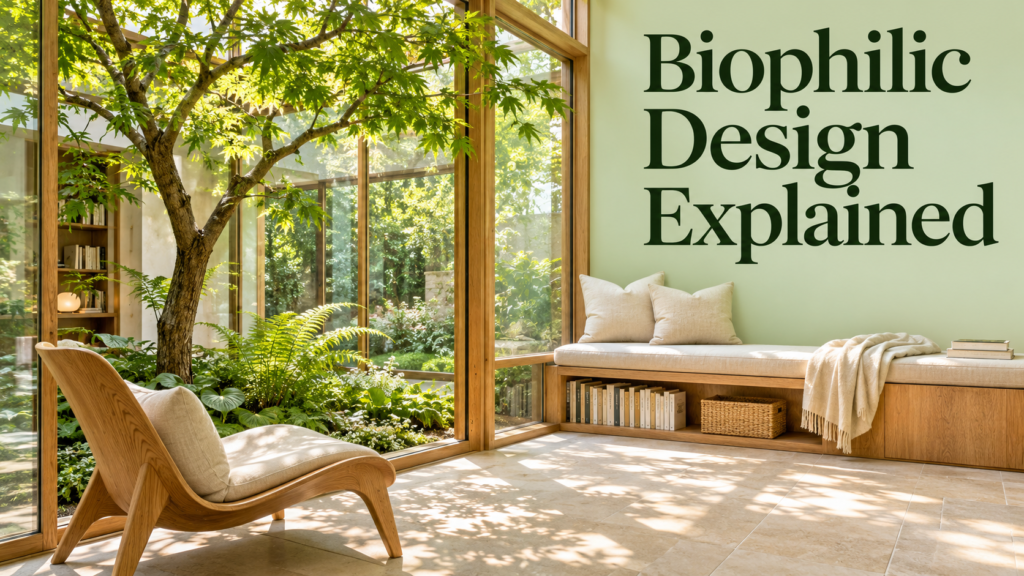
Biophilic design has moved from architecture journals into everyday home design. It goes far beyond adding a few houseplants: biophilic design is about connecting people with nature through light, views, plants, natural materials, water, fresh air, organic shapes and spaces that feel safe and restorative. Done well, it can make homes calmer, healthier and more enjoyable to live in.
This guide explains biophilic design in plain terms: where the idea comes from, what the research says, the 14 patterns of biophilic design, how biophilic design differs from eco or sustainable design, and practical ways to apply it in every room of a UK home, from low-cost changes to bigger projects such as rooflights, garden connections and living walls.
Table of Contents
What Is Biophilic Design?
Biophilic design is the practice of bringing natural elements, patterns and processes into the built environment. Gensler describes it as the practice of connecting people to nature within the built environment and our communities.
Learn Architecture defines biophilic design principles as a set of strategies that bring natural elements, patterns, and processes into the built environment to improve occupant health, mood, and productivity.
Where the Idea Comes From
The word “biophilia” means a love of life or living things. It was popularised by biologist E.O. Wilson. Homebuilding explains that the origins of biophilic design can be traced back to American biologist and theorist Edward O Wilson, who popularised the term ‘biophilia’ (literally a love of nature) in his 1984 book of the same name.
Wilson defined biophilia as “the innate tendency to focus on life and lifelike processes”. His key insight was that this biophilic propensity developed as part of evolutionary survival and, thus, encompasses certain characteristics that remain with humans even in modern cities.
Yale professor Stephen Kellert later developed biophilic design as a practical discipline. Together, Wilson and a fellow ecologist, Kellert, hypothesized that nourishment of this innate love and connection to nature is essential for modern urban human wellbeing.
Kellert criticised the way modern buildings cut people off from nature. He wrote: “The modern assumption that humans no longer need to affiliate with nature is revealed in the widespread practice of placing people in sensory deprived and artificial settings such as office buildings, and noted that the very simple introduction of natural lighting, outside views and vegetation can result in enhanced health and productivity”.
Biophilic Design vs Eco Design
Biophilic design and eco design overlap but aren’t the same thing.
| Biophilic Design | Eco/Sustainable Design |
|---|---|
| Focuses on people’s connection to nature | Focuses on environmental impact |
| Prioritises wellbeing, comfort and mood | Prioritises energy, carbon and resources |
| Views, light, plants, natural materials, water | Insulation, renewables, efficiency |
| Can be achieved in existing homes cheaply | Often requires building upgrades |
Designer Oliver Heath, quoted by Homebuilding, believes that biophilic design is a more human-centred approach to design than the carbon-led approach that typifies an eco home. Homebuilding adds: Rather than focusing on the building’s properties, biophilic design focuses on the connection it affords those living in it to nature.
The two can sometimes conflict. Homebuilding notes that fresh air is another element of nature that biophilic design prioritises a connection with, however, this can often be at odds with the airtightness goals of an eco home. The best homes balance both, for example with mechanical ventilation, opening windows and good insulation.
What Does the Research Say?
Wellbeing, Productivity and Creativity
The most widely quoted study is the Human Spaces report, which surveyed thousands of office workers. It found that employees exposed to natural elements had well-being levels 15 percent higher than those without. The study covered 7,600 office workers from 16 countries around the world.
Learn Architecture summarises the findings: employees in work environments with natural elements are 6% more productive, 15% more creative, and report 15% higher levels of wellbeing compared to those in environments without such elements.
The same report found many workers lacked nature at work: 47% have no natural light and 58% have no plants.
What People Want Most
Natural light came top. The top five elements most wanted in the office space were Natural light (44%), Indoor plants (20%), View of the sea (17%), Quiet working space (19%) and Bright colours (15%).
Health Benefits
Terrapin Bright Green links visual connection with nature to lowered blood pressure and heart rate. Terrapin co-founder William Browning says: “Biophilic design can reduce stress, enhance creativity and clarity of thought, improve our well-being and expedite healing.”
Allwork notes that research has shown that biophilic design reduces stress, expedites healing, and improves cognitive function, creativity, and wellbeing.
A Note on the Evidence
Much of the research focuses on workplaces, schools and hospitals rather than homes, and some findings are based on surveys. The principles are widely accepted, but results in any individual home will vary.
The 14 Patterns of Biophilic Design
The most influential framework comes from Terrapin Bright Green. Learn Architecture notes that the most widely referenced framework comes from Terrapin Bright Green’s “14 Patterns of Biophilic Design” (2014), developed by William Browning, Catherine Ryan, and Joseph Clancy.
The patterns build on Kellert’s work. Stephen Kellert, a Yale University professor who pioneered much of the academic groundwork, had previously identified over 70 mechanisms for creating biophilic experiences, and the 14 Patterns distilled those into a practical tool for designers.
Three Categories
Terrapin groups the patterns into three categories: nature in the space (real natural elements), natural analogues (man-made elements that mimic nature) and the nature of the space (how spaces are shaped).
| Category | Pattern | Home Example |
|---|---|---|
| Nature in the Space | 1. Visual connection with nature | Garden views, plants |
| 2. Non-visual connection with nature | Birdsong, scent of herbs, texture of wood | |
| 3. Non-rhythmic sensory stimuli | Leaves moving, curtains in a breeze | |
| 4. Thermal and airflow variability | Opening windows, sunny window seats | |
| 5. Presence of water | Water features, ponds, views of water | |
| 6. Dynamic and diffuse light | Rooflights, dappled light, sheer curtains | |
| 7. Connection with natural systems | Seasonal planting, rain on a rooflight | |
| Natural Analogues | 8. Biomorphic forms and patterns | Botanical wallpaper, curved furniture |
| 9. Material connection with nature | Wood, stone, wool, linen, clay | |
| 10. Complexity and order | Natural textures, layered planting | |
| Nature of the Space | 11. Prospect | Long views, open-plan spaces |
| 12. Refuge | Window seats, reading nooks, snugs | |
| 13. Mystery | Winding paths, partially hidden views | |
| 14. Risk/peril | Balconies, glass floors, stepping stones |
Terrapin has since added a fifteenth pattern. On the tenth anniversary of the framework, Terrapin added a fifteenth pattern: Awe.
Combine Patterns
The best biophilic spaces layer several patterns. Allwork notes that great biophilic design is varied and combines several patterns for optimal results, and that these patterns can be applied in different scales: micro-space, rooms, entire buildings, neighborhoods, campuses, or even city-wide.
Kellert’s Approach: Direct, Indirect and Space-Based
Kellert divided biophilic experiences into three types:
| Type | Meaning | Examples |
|---|---|---|
| Direct experience of nature | Real contact with nature | Light, air, water, plants, animals, views |
| Indirect experience of nature | Representations of nature | Natural materials, colours, images, shapes |
| Experience of space and place | How spaces feel | Prospect, refuge, connection between spaces |
Biophilic Design Principles for Homes
You don’t need a big budget. Learn Architecture notes that biophilic design principles for homes don’t require a budget for living walls or rooftop gardens.
1. Maximise Natural Light
Natural light is the most important biophilic element. One guide calls adding as much natural light as possible throughout your home a crucial element of biophilic design.
Ideas:
- Keep windows clear of clutter
- Use sheer curtains or blinds that filter light
- Add mirrors to bounce light into darker rooms
- Fit rooflights or sun tunnels in dark spaces
- Choose glazed internal doors
- Use pale, reflective surfaces in dark rooms
2. Create Views of Nature
- Position sofas, desks and dining tables to face windows
- Frame garden views with large windows or glazed doors
- Plant trees and shrubs visible from inside
- Add window boxes in flats
- Hang bird feeders where you can see them
3. Bring in Plants
Plants are the easiest way to add nature. Wikipedia notes that greenery should be abundant (i.e., make use of green walls or many potted plants) and some vegetation should flower; plants have been proven to increase physical health, performance, and productivity and reduce stress.
| Room | Plant Ideas |
|---|---|
| Living room | Fiddle-leaf fig, monstera, olive tree, rubber plant |
| Bedroom | Snake plant, peace lily, ZZ plant |
| Bathroom | Ferns, pothos, calathea (humidity lovers) |
| Kitchen | Herbs, trailing plants on shelves |
| Home office | Pothos, spider plants, small succulents |
| Hallway | Low-light plants such as ZZ plants |
| Dark corners | Faux plants or grow lights |
4. Use Natural Materials
| Material | Biophilic Effect |
|---|---|
| Wood | Warmth, grain, texture |
| Stone | Grounding, connection to landscape |
| Wool | Softness, warmth |
| Linen and cotton | Natural texture |
| Rattan, cane, jute | Organic weaves |
| Clay and lime plaster | Earthy, breathable walls |
| Cork | Warm, tactile |
5. Choose Nature-Inspired Colours
Gensler notes that the ecological valence theory suggests that we prefer nature-resembling colours such as green and blue, but adds that not all natural environments are ‘green,’ and so design choices should be tailored to the local ecosystem.
| Colour | Natural Reference |
|---|---|
| Greens | Forests, gardens, meadows |
| Blues | Sky, sea, water |
| Earthy browns | Soil, wood, bark |
| Sand and stone | Beaches, rock |
| Terracotta | Clay, earth |
| Warm whites | Natural light, chalk |
6. Use Organic Shapes and Patterns
- Curved sofas and rounded furniture
- Arched doorways and mirrors
- Botanical wallpaper and fabrics
- Leaf, wave and branch patterns
- Natural textures that combine complexity and order
7. Add Water
- Tabletop water features
- Aquariums
- Garden ponds and fountains visible from inside
- Rainwater features or water butts in view
- Images or artwork of water
8. Improve Fresh Air and Thermal Variety
- Opening windows for cross-ventilation
- Trickle vents and good mechanical ventilation
- Sunny window seats for warmth
- Cool, shaded spaces in summer
- Air purifying plants (with realistic expectations)
9. Create Refuge and Prospect
Humans like spaces where we can see out (prospect) while feeling protected (refuge).
- Window seats and reading nooks
- Snugs with low lighting
- Canopy beds
- High-backed chairs facing views
- Open-plan spaces with cosy corners
10. Engage All the Senses
Biophilic design isn’t just visual.
| Sense | Biophilic Ideas |
|---|---|
| Sight | Views, plants, natural light |
| Sound | Birdsong, water, rustling leaves |
| Smell | Herbs, flowers, wood, fresh air |
| Touch | Wood, stone, wool, linen, clay |
| Temperature | Sun patches, breezes, cool stone floors |
11. Connect With Natural Rhythms
- Use warm lighting in the evening and bright light in the morning
- Smart lighting that follows the day
- Seasonal decor: flowers, branches, foraged materials
- Windows that let you watch weather and seasons
Biophilic Design Room by Room
Living Room
- Seating facing garden views
- Large floor plants and trailing plants
- Wood and stone surfaces
- Wool rugs and linen curtains
- Botanical artwork or wallpaper
- Fireplace or wood burner (natural fire)
Kitchen
- Herbs on windowsills
- Wood or stone worktops
- Views to the garden from the sink
- Rooflights over the island or dining table
- Clay or handmade tiles
Bedroom
- Natural fibres in bedding
- Calm greens, blues and earthy tones
- Plants and natural textures
- Blackout and sheer curtains for natural light cycles
- Window views of trees or sky
Bathroom
- Humidity-loving plants
- Stone, wood and natural tiles
- Rooflights for daylight
- Spa-like water features
- Views to the garden (with privacy glass)
Home Office
- Desk with a view of nature
- Plants within sight
- Daylight with glare control
- Natural materials and calming colours
Hallway
- Plants by the front door
- Natural flooring such as stone or wood
- Mirrors to bounce light
- Botanical prints
Children’s Rooms
- Nature-themed wallpaper and art
- Easy-care plants
- Natural materials
- Reading nooks and dens
Bigger Biophilic Projects
| Project | Biophilic Benefits |
|---|---|
| Rooflights and sun tunnels | Dynamic natural light |
| Bifold or sliding doors | Indoor-outdoor connection |
| Garden rooms | Immersion in the garden |
| Green roofs | Views of planting, wildlife |
| Living walls | Abundant greenery |
| Courtyards and atriums | Light and planting at the heart of the home |
| Window seats | Refuge with a view |
| Ponds and water features | Presence of water |
Homebuilding notes that a green roof or living wall has plenty of ecological benefits to offer the eco home, but in biophilic design, the benefits are focussed on the people who enjoy these design elements.
Living Walls at Home
Living walls range from simple modular planters to fully irrigated systems. Smaller DIY pocket planters can cost from tens to a few hundred pounds, while professionally installed irrigated living walls typically cost much more and need ongoing maintenance. Consider:
- Light levels (or grow lights)
- Watering systems
- Waterproofing walls
- Plant choice and maintenance
- Weight and fixings
Budget Biophilic Design Ideas
| Idea | Approximate Cost |
|---|---|
| Houseplants | £5–£50 each |
| Herbs on the windowsill | Under £20 |
| Linen cushion covers | £15–£50 |
| Jute rug | £50–£300 |
| Botanical prints | £10–£100 |
| Sheer curtains | £20–£100 |
| Tabletop water feature | £30–£150 |
| Bird feeder outside a window | £10–£40 |
| Rearranging furniture to face views | Free |
| Opening windows daily | Free |
These are approximate prices and vary by retailer.
Biophilic Design and Sustainability
Biophilic design works best alongside sustainable choices:
- Choose FSC-certified wood and reclaimed materials
- Buy peat-free compost for plants
- Choose second-hand natural-material furniture
- Use low-VOC paints
- Encourage wildlife in your garden
- Balance fresh air with insulation and efficient ventilation
Common Biophilic Design Mistakes
| Mistake | Better Approach |
|---|---|
| Relying only on houseplants | Combine light, views, materials and textures |
| Plants in the wrong light | Match plants to room conditions |
| Blocking windows | Keep views and daylight clear |
| Too many faux elements | Mix real and representational nature |
| Ignoring ventilation | Balance fresh air with insulation |
| Overcrowding with greenery | Leave space and order alongside complexity |
| Cold, sterile materials | Use wood, stone, wool and linen |
| Treating it as a trend | Design for long-term wellbeing |
Biophilic Design Checklist
- Maximise natural light in every room
- Arrange furniture to face views of nature
- Add plants suited to each room
- Use natural materials: wood, stone, wool, linen, clay
- Choose nature-inspired colours
- Add organic shapes and botanical patterns
- Bring in water where possible
- Improve ventilation and fresh air
- Create cosy refuge spaces with views
- Engage all the senses
- Connect your home to the garden
- Consider bigger projects such as rooflights or garden rooms
Final Thoughts
Biophilic design is about reconnecting people with nature where they live. It’s rooted in E.O. Wilson’s idea of biophilia, our innate attraction to life, and was developed into a design discipline by Stephen Kellert and later organised into Terrapin Bright Green’s 14 patterns. Research such as the Human Spaces report links natural elements with around 15% higher wellbeing, 15% greater creativity and 6% higher productivity in workplaces. At home, start with natural light, views and plants, then add natural materials, nature-inspired colours, organic shapes, water, fresh air and cosy refuges. Many biophilic changes cost little or nothing, while larger projects such as rooflights, garden rooms and living walls can transform how your home feels.
Frequently Asked Questions
1. What is biophilic design?
Biophilic design brings nature into buildings through natural light, views, plants, natural materials, water, fresh air and nature-inspired shapes to improve wellbeing.
2. What are the benefits of biophilic design?
Research links it to reduced stress, better mood and improved creativity and productivity, with one major study finding 15% higher wellbeing among office workers.
3. How can I add biophilic design to my home cheaply?
Maximise daylight, arrange seating to face views, add houseplants and herbs, and use natural materials such as wood, linen, wool and jute.