Bookshelves can be the most characterful part of a room, or the most cluttered. Styled well, they show off your books and favourite objects, add colour and texture, and make a living room, study or bedroom feel personal and finished. Styled badly, they look crammed, chaotic or oddly empty.
This guide explains how to style bookshelves like an interior designer: how to edit, arrange and balance books and objects; the rule of three; mixing vertical and horizontal books; colour approaches; how to style shelves full of real books; lighting and backgrounds; ideas for different rooms; built-in alcove shelving costs in the UK; and the most common mistakes to avoid.
Table of Contents
Why Bookshelf Styling Matters
Bookshelves are a focal point in many rooms, especially in UK homes with alcoves either side of a chimney breast. One design studio notes that bookshelves can look unbalanced or too bare, and that can detract from what is an otherwise amazing room.
Good styling should:
- Show off your books and personality
- Create balance and visual rhythm
- Add colour, texture and height variation
- Keep things practical so you can still reach your books
- Avoid clutter
Decorative vs Functional Shelves
Not every bookcase needs the same approach. Designer Emily Henderson’s blog notes that there’s bookshelves that are functional? and others that are just decorative. A library wall full of well-used books needs a different approach from a styled living room shelf. Both can look beautiful.
Step 1: Empty and Edit
Start by taking everything off the shelves. One design writer notes that starting fresh also helps you decide what truly deserves a spot on display. Not everything needs to go back up, and that’s perfectly okay for creating a cleaner, more intentional look.
Editing Tips
- Donate or sell books you’ll never read again
- Remove broken or tired objects
- Group items by type: books, ceramics, frames, plants, baskets
- Keep only objects you love or that tell a story
- Store the rest in cupboards or boxes
Step 2: Consider the Background
The back of your shelves matters. One design studio advises: Don’t forget the background of your shelves.
| Background Idea | Effect |
|---|---|
| Paint the back a contrasting colour | Makes objects stand out |
| Paint shelves and wall the same colour | Seamless, colour-drenched look |
| Wallpaper | Pattern and personality |
| Grasscloth or textured wallpaper | Warm, tactile backdrop |
| Mirror panels | Reflects light, adds depth |
| Wood panelling | Library-style warmth |
| Dark colours (navy, green, charcoal) | Dramatic, cosy |
Dark backgrounds make light-coloured ceramics and books pop, while pale backgrounds make shelves feel light and airy.
Step 3: Start With Large Anchor Pieces
Place the largest items first: big books, large vases, framed art, sculptural pieces or baskets. These anchor the shelves and set the structure.
Think about weight. One furniture guide notes that larger and heavier books belong lower down, where they anchor the whole piece visually.
Zigzag Balance
Distribute large items across the shelves in a zigzag pattern rather than lining them up on one side. This keeps the eye moving and balances visual weight.
Step 4: Mix Vertical and Horizontal Books
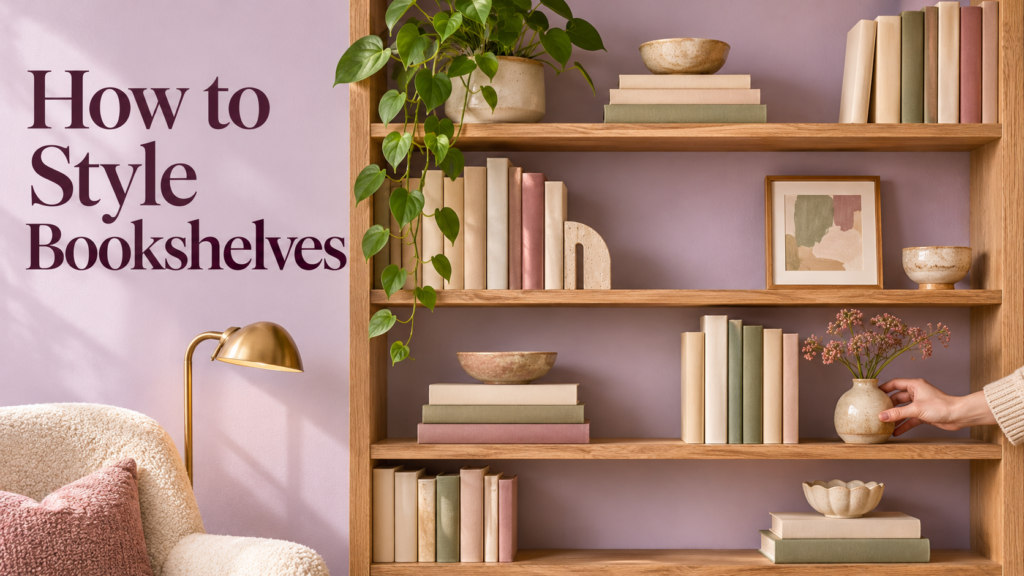
This is the single most effective styling trick. One design studio explains that one of the best ways to do that is to offer both vertical and horizontal elements. Even if your shelves are mostly filled with books, it’s best to stack some and then prop others.
Horizontal stacks have a double purpose. Horizontal stacks interrupt repetition and create resting places for bowls, boxes, or small framed photos.
Tips for Mixing Books
- Stack 3–5 books horizontally, largest at the bottom
- Place a small object on top of horizontal stacks
- Use vertical rows with bookends or objects at the end
- Alternate stacks from side to side on different shelves
- Lay coffee-table books flat to show off their covers
Spread horizontal stacks around. One guide advises: Don’t stack all your horizontal books in one place. Distribute them across different shelves to create visual balance throughout the entire bookcase.
Step 5: Use the Rule of Three
Grouping items in odd numbers, especially threes, is a classic styling technique. One stylist explains that grouping items in odd numbers, particularly threes, can create a visually pleasing and balanced arrangement. When you place three objects together, it allows for a sense of movement and dynamism.
Low, Medium, Tall
Give each group a range of heights. A stack of horizontal books creates a low element that anchors the shelf. A tall vase or sculpture adds a vertical thrust. A medium-height object bridges the two.
Repeat Colours and Materials Too
The rule of three works for colours and textures as well. Repeating the same shade or material three times throughout your shelves ties everything together beautifully without looking too matchy or boring.
The rule isn’t strict. One stylist admits it’s sometimes okay to break that “odd numbers trump all” decor rule, because sometimes 3 pieces feel cluttered and 2 items look just right.
Step 6: Leave Breathing Space
Overstuffing is the most common mistake. One designer guide warns that if there’s one mistake that instantly marks a shelf as amateur, it’s cramming every inch full.
A useful rule of thumb is: one-third books, one-third accessories, and one-third empty space per shelf. This applies mainly to decorative shelves; working library shelves can be fuller.
Bookshelf Styling Formulas
Simple formulas make styling easier.
| Formula | What to Include |
|---|---|
| Stack and accent | 2–3 horizontal books with a small object on top |
| Row and bookend | Vertical books finished with a vase or bookend |
| Anchor, stack, accent | One tall object, one stack, one small object |
| Art and books | A leaning frame with books in front |
| Basket base | Baskets or boxes on lower shelves for storage |
| Plant and stack | A trailing plant beside a stack of books |
One stylist’s favourite starter formula is Two or three books stacked horizontally with a small decorative object on top.
Another suggests the Anchor + Stack + Accent, which combines one tall object (vase or sculpture) and one horizontal stack of books with a small accent.
What to Display on Bookshelves
| Object Type | Examples |
|---|---|
| Ceramics and pottery | Vases, bowls, jugs |
| Art | Small framed prints, leaning canvases |
| Plants | Trailing pothos, small succulents, dried flowers |
| Sculptural pieces | Busts, wooden objects, stone pieces |
| Personal items | Travel finds, heirlooms, photos |
| Natural objects | Shells, stones, driftwood, pinecones |
| Storage | Baskets, boxes, lidded pots |
| Lighting | Small lamps, picture lights |
| Candles | Candlesticks, candle holders |
| Records | Vinyl collections in the lower shelves |
Framed Art on Shelves
Leaning art is a relaxed, layered look. One stylist advises that the picture frames can be a vertical or horizontal, but make sure whatever is in front is shorter.
Show Personality
Shelves should reflect who you are. One designer notes: Your shelf should be a reflection of who you are. Mix in travel souvenirs, family heirlooms, children’s artwork or collections.
Colour Approaches
| Approach | Effect | Best For |
|---|---|---|
| Natural (mixed spines) | Relaxed, lived-in | Real libraries |
| Colour-blocked or rainbow | Bold, playful | Modern homes, children’s rooms |
| Tonal (similar shades grouped) | Calm, curated | Living rooms |
| Neutral (spines reversed or covered) | Minimal, uniform | Decorative shelves (but hard to find books) |
| Mixed with accent colour | Cohesive | Most rooms |
Limit Your Colour Palette
Too many colours can look messy. One guide warns that if every object on the shelf comes from a different color family, the shelf reads as clutter before anyone notices the individual pieces.
Pick two or three accent colours that link to the rest of the room, such as cushions, rugs or artwork.
Turning Spines Backwards
Turning books spine-in creates a neutral, uniform look, but makes it almost impossible to find books. It suits decorative shelves rather than functional libraries.
Styling Shelves Full of Real Books
If you’re a keen reader, your shelves will mostly be books, and that’s fine. One stylist notes you can always style your bookshelves with just your books, full stop.
Tips for Book-Heavy Shelves
- Organise by genre, author, size or colour
- Break long runs with occasional horizontal stacks
- Add a small object every two or three shelves
- Use matching bookends for neatness
- Keep frequently read books at eye level
- Put large, heavy books on lower shelves
- Align spines to the front edge for a tidy look
One designer formula for book-heavy shelves uses books organized by theme or genre with horizontal stacks to break up visual weight, plus a small item (like a paperweight or magnifying glass) every 2–3 shelves.
Lighting Your Bookshelves
Lighting turns shelves into a feature, especially in the evening.
| Lighting Type | Effect |
|---|---|
| LED strips under shelves | Soft glow, highlights objects |
| Picture lights above shelves | Classic library look |
| Puck lights | Spotlight individual objects |
| Small table lamps on shelves | Cosy, layered |
| Wall lights on either side | Frames the bookcase |
| Spotlights angled at shelves | Highlights the whole unit |
Lighting Tips
- Use warm white LEDs (2700–3000K)
- Hide cables and drivers
- Use dimmers or smart controls
- Battery-powered lights avoid rewiring
- Plan built-in lighting before carpentry starts
Bookshelf Styling by Room
Living Room
- Alcove shelving either side of the fireplace
- Symmetrical styling for a calm look
- Mix books, ceramics and art
- Include a small lamp or picture lights
- Coordinate with sofa and cushion colours
Home Office
- Functional books and files within easy reach
- Baskets and boxes for hidden storage
- Plants for a biophilic touch
- A tidy backdrop for video calls
- Desk accessories on lower shelves
Bookshelves make a great video call background, so style the shelves behind your desk carefully.
Bedroom
- Calm colours and minimal objects
- Favourite novels and bedside reads
- Candles, plants and soft lighting
- Avoid clutter for a restful feel
Children’s Rooms
- Forward-facing book displays for picture books
- Low shelves within reach
- Baskets for toys
- Bright colours and fun objects
- Anchor bookcases securely to the wall
Hallway and Landing
- Slim shelves or built-in bookcases
- Keep objects minimal to avoid knocks
- Use the space for overflow books
Kitchen
- Cookbooks on open shelves
- Ceramics, jars and plants
- Keep away from steam and splashes
Types of Bookshelves
| Type | Best For |
|---|---|
| Freestanding bookcase | Flexible, renters |
| Built-in alcove shelving | Period homes, chimney breast alcoves |
| Floor-to-ceiling library wall | Large book collections |
| Floating shelves | Minimal look, small spaces |
| Ladder shelves | Casual, decorative display |
| Cube storage units | Children’s rooms, mixed storage |
| Wall-to-wall built-ins with cupboards | Combining storage and display |
| Picture ledges | Forward-facing books and art |
| Under-stairs shelving | Using dead space |
Safety Tip
Anchor tall freestanding bookcases to the wall, especially in homes with children, to stop them tipping over.
Built-In Bookshelf and Alcove Shelving Costs in the UK
Built-in shelving is a popular upgrade, especially in Victorian and Edwardian homes with alcoves.
Typical Costs
| Item | Typical Cost |
|---|---|
| Basic alcove shelving (floating shelves, supply and fit) | From around £400 |
| Alcove cupboard with shelving above (MDF, painted) | £850–£1,500 per alcove |
| Pair of matching alcove units | £1,800–£4,000 |
| Built-in alcove cabinets with bookcases | £1,800–£2,800 |
| 2m × 2m hardwood built-in bookcase | Up to around £3,700 |
| Bespoke media wall with shelving | £2,000–£5,000 |
House Designer gives these alcove prices: Basic alcove shelving (floating shelves, supply and fit) – from around £400, Alcove cupboard with shelving above (MDF, painted finish) – £850 to £1,500 per alcove and A pair of matching alcove units (cupboards, shelving, painted) – £1,800 to £4,000. It adds that most professionally built media walls in the UK currently cost between £2,000 and £5,000.
MyJobQuote gives a similar example: built-in alcove cabinets with book casings from £1800 to £2800.
For hardwood, HaMuch says that for a 2m x 2m hardwood built-in bookcase that has 4 shelves, expect it to cost at least £3,000 plus at least two day’s labour. That means you could spend up to £3,700.
Material and Labour Costs
| Item | Typical Cost |
|---|---|
| MDF or plywood shelving | Around £70 per metre |
| Hardwood shelving | Around £230 per metre |
| Glass shelving | Around £126 per metre |
| Carpenter day rate | £300–£450 |
| Painter/decorator day rate | £250–£400 |
Checkatrade reports that shelving typically starts at around £70 per metre for MDF or plywood, rising to £230 per metre for hardwood and £126 per metre for glass shelving. This is for materials only. It lists carpenter rates of Per day£300 – £450.
What Affects the Cost?
- Material (MDF, plywood, hardwood)
- Size and number of shelves
- Cupboards and doors below
- Painting or finishing
- Integrated lighting
- Wall condition and uneven alcoves
- Location (London is usually more expensive)
Uneven walls add cost. House Designer notes that alcoves, sloped ceilings and uneven walls require more precise carpentry, which increases labour time and cost.
Do Built-In Bookshelves Add Value?
Well-made built-ins can appeal to buyers. HaMuch notes that built-in bookcases will add value – as long as they’re done properly.
Budget Bookshelf Styling Ideas
- Shop your home: use objects you already own
- Paint the back: a tester pot can transform a bookcase
- Use peel-and-stick wallpaper: on the back panel
- Buy second-hand books: for colour and texture
- Use vintage finds: charity shop ceramics and frames
- Add plants: cuttings and trailing plants are cheap
- Battery LED strips: easy shelf lighting
- Rearrange regularly: seasonal refreshes keep shelves interesting
- Use baskets: hide clutter cheaply
- Upgrade a flat-pack bookcase: with paint, trim or new handles
Seasonal Styling
Refreshing shelves seasonally keeps them interesting:
- Spring and summer: lighter colours, fresh flowers, natural textures
- Autumn: dried grasses, warm-toned ceramics, candles
- Winter: greenery, fairy lights, festive touches
One stylist suggests that in spring and summer you keep things much more light and airy for spring and summer, with pretty flowers and natural textures.
Common Bookshelf Styling Mistakes
| Mistake | Better Approach |
|---|---|
| Overstuffing shelves | Leave breathing space |
| All books vertical | Mix vertical and horizontal |
| Lining up identical objects | Vary heights and shapes |
| Too many colours | Limit the palette |
| Large items all on one side | Use a zigzag balance |
| Ignoring the back panel | Paint or wallpaper it |
| Too many tiny objects | Use fewer, larger pieces |
| Heavy items on top shelves | Keep heavy books low |
| No lighting | Add strip lights or picture lights |
| Not anchoring tall bookcases | Secure to the wall |
Bookshelf Styling Checklist
- Empty the shelves completely
- Edit and group items
- Consider painting or wallpapering the back
- Place large anchor pieces first
- Add books, mixing vertical and horizontal
- Add objects in groups of three
- Vary heights: low, medium, tall
- Repeat colours and materials
- Leave breathing space
- Add lighting
- Step back and adjust
Final Thoughts
Styling bookshelves well is about balance, variety and editing. Start by emptying and editing, then place large anchor pieces, mix vertical rows with horizontal stacks, and group objects in threes with a range of heights. Limit your colour palette, repeat colours and materials, and leave breathing space rather than filling every inch. Painted or wallpapered backs and warm LED lighting make shelves a real feature. If you’re planning built-in shelving, basic alcove shelves start from around £400, painted alcove cupboards with shelving cost about £850–£1,500 per alcove, and a matching pair typically costs £1,800–£4,000.
Frequently Asked Questions
1. How do you style a bookshelf without it looking cluttered?
Edit first, mix vertical and horizontal books, group objects in threes, limit colours and leave some empty space on each shelf.
2. What is the rule of three for shelves?
It means grouping items in threes, ideally in different heights and shapes, to create a balanced and natural-looking display.
3. How much do built-in alcove bookshelves cost in the UK?
Basic alcove shelving starts from around £400, while painted alcove cupboards with shelving cost around £850–£1,500 per alcove.