Layered lighting is the technique professional designers use to make homes feel warm, functional and inviting. Instead of relying on one central ceiling light, a layered scheme combines several light sources, each with its own job, at different heights and brightness levels. The result is a room that works well for everyday tasks and can also change mood at the touch of a switch.
This guide explains layered lighting from the ground up: the three main layers, how to calculate brightness in lumens and lux, colour temperature and CRI, switching and dimming, room-by-room plans, UK installation and lighting designer costs, Building Regulations, smart controls and the most common mistakes homeowners make.
Table of Contents
What Is Layered Lighting?
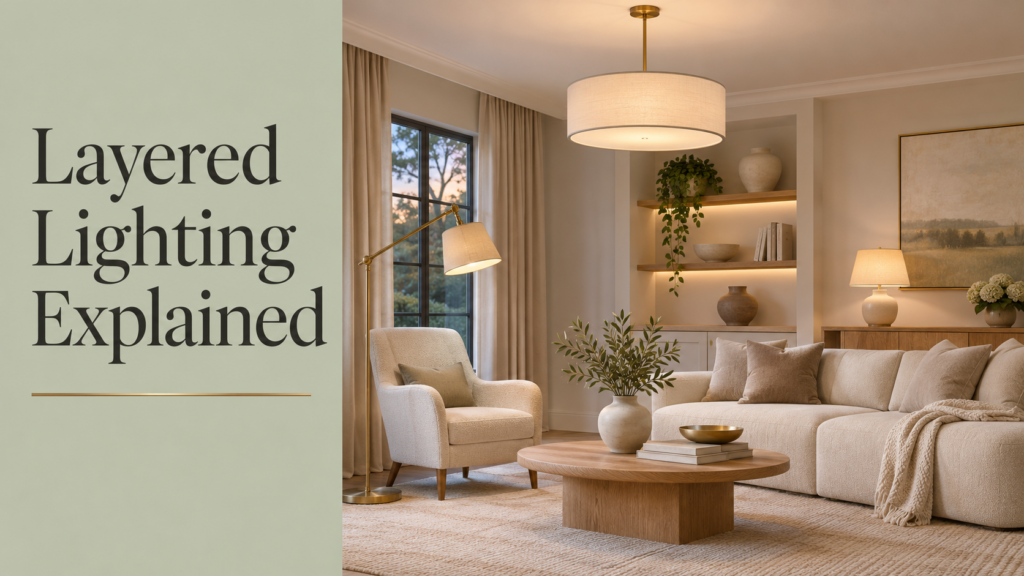
Layered lighting means using different types of light together, each serving a different purpose. Just as an interior designer would layer colors or fabric, lighting designers use three layers of light – ambient, accent, and task lighting – to enhance a room’s visual appeal.
The difference is easy to see. A room with only ambient light is functional but flat; add task light and it works; add accent light and it comes alive.
Why One Ceiling Light Isn’t Enough
A single pendant in the middle of the ceiling creates:
- Harsh, flat light with heavy shadows
- Dark corners and poorly lit work areas
- Glare when you look up
- No way to change the mood
- Rooms that feel smaller and colder
UK retailer Lumination sums it up neatly: Most rooms are not badly designed. They are just badly lit.
The Three Layers of Lighting
| Layer | Purpose | Typical Fittings |
|---|---|---|
| Ambient | General, overall illumination | Pendants, flush ceiling lights, downlights, cove lighting |
| Task | Focused light for specific activities | Desk lamps, under-cabinet lights, reading lights, mirror lights |
| Accent | Highlights features and adds depth | Picture lights, spotlights, LED strips, uplighters, wall washers |
Layer 1: Ambient Lighting
Ambient lighting is the foundation. It lets you move around safely and see the whole room. Ambient is your base layer of illumination.
Ambient light can be:
- Direct: downlights and pendants shining downward
- Indirect: light bounced off ceilings or walls, such as cove lighting and uplighters
- Diffused: light softened through fabric, opal glass or paper shades
For ambient fixtures, a combination of recessed downlights and a ceiling pendant usually works well.
Layer 2: Task Lighting
Task lighting is brighter, focused light for activities like cooking, reading, working, shaving or applying make-up. Task lighting is focused light for specific activities.
Examples include:
- Under-cabinet strips over kitchen worktops
- Desk lamps in home offices
- Swing-arm wall lights beside beds
- Pendants over kitchen islands
- Illuminated or side-lit bathroom mirrors
You need some task light in nearly every room. You will need some kind of task lighting in almost every space of your home, with ambient and accent lighting covering the rest of the room.
Layer 3: Accent Lighting
Accent lighting adds character, drama and depth by drawing the eye to particular features: artwork, alcoves, shelves, fireplaces, textured walls, plants or architectural details.
The key is contrast. Typically, the accent light is about three times brighter than the room’s ambient lighting.
Accent lighting can be split into two types. Accent lighting is often used to draw attention to a particular object or area within your home. We call this display lighting. The other type, sometimes called illusion lighting, uses light to change how a space feels, for example by washing walls to make a room seem larger or using under-plinth strips to make units appear to float.
Accent Lighting Isn’t Always Necessary
Not every room needs all three layers at full strength. Lumination notes that if a room is small, has low ceilings, or already feels well-balanced with just ambient and task light, adding accent fixtures can make it feel cluttered or over-lit.
One Fitting, Several Roles
Layers often overlap. For instance, downlights can be used as both general illumination and accent lighting. Similarly, a wall sconce can be used as both accent and task lighting.
The Fourth Layer: Decorative and Natural Light
Many designers add extra considerations:
- Decorative lighting: statement pendants, chandeliers and sculptural lamps that are features in their own right
- Natural light: daylight from windows, skylights and roof lanterns, which should be planned first
- Safety and night lighting: low-level lights for stairs, hallways and routes to bathrooms
One design guide recommends layering light with daylight planned first.
Understanding Lumens, Lux and Watts
Lumens vs Watts
With LEDs, wattage no longer tells you how bright a bulb is. Watts measure power consumed; lumens measure light produced. An old 60 W incandescent bulb gave about 800 lumens; an LED gives the same 800 lumens for around 8–10 W.
Lumens vs Lux
| Term | What It Measures |
|---|---|
| Lumens (lm) | Total light emitted by a bulb or fitting |
| Lux (lx) | Light landing on a surface (lumens per square metre) |
| Watts (W) | Electrical power used |
| Kelvin (K) | Colour temperature of the light |
| CRI | How accurately colours appear (0–100) |
In plain terms, one lux is one lumen spread over one square metre. Lumens describe the source; lux describes the result on your counter, your page, your floor.
How Many Lumens Does a Room Need?
A widely used rule of thumb: 100 lm per sqm is appropriate for living rooms and 300 lm per sqm for ‘working rooms’ such as kitchens or bathrooms.
| Room | Approximate Lumens per m² |
|---|---|
| Living room | 100–200 |
| Bedroom | 100–150 |
| Hallway | 50–100 |
| Dining room | 100–200 (more over the table) |
| Kitchen (general) | 300+ |
| Kitchen worktops / desks | 300–500+ (task areas) |
| Bathroom | 200–300 (more at the mirror) |
| Home office | 300–500 |
Worked Example
For a 4m × 4m living room (16m²) at about 150 lumens per m²:
- 16 × 150 = 2,400 lumens in total
- Ambient: a pendant plus wall lights providing about 1,400 lumens
- Task: a reading floor lamp providing about 600 lumens
- Accent: picture lights and shelf strips providing about 400 lumens
The point of layering is to spread those lumens across several sources rather than putting them all in one fitting. As Gantri puts it, we use layers of lighting so we don’t have to explode all those lumens altogether in a room.
Don’t Over-Light
A common mistake is filling ceilings with too many downlights. One interior designer warns that a modest bedroom is comfortable with a few downlights plus a lamp, not the eight-light grid some ceiling contractors love to draw.
Colour Temperature and CRI
Colour Temperature
| Kelvin | Appearance | Best Use |
|---|---|---|
| 2200–2700K | Warm white | Living rooms, bedrooms, dining rooms |
| 2700–3000K | Soft white | Most homes; kitchens and bathrooms for a warmer feel |
| 3500–4000K | Cool/neutral white | Task areas, utility rooms, garages, offices |
| 5000–6500K | Daylight | Workshops; rarely suitable in living spaces |
Remember that a lower Kelvin number means warmer light: warm light is a LOW Kelvin number.
For task areas, some suppliers prefer cooler light. Lumination suggests cooler colour temperatures around 3500K–4500K usually work best because they improve focus and visibility without feeling too clinical. In homes, many designers still keep task lighting at 3000K so it matches the rest of the room.
Keep It Consistent
Mixing colour temperatures in one space usually looks like a mistake. One designer advises: Mixing temperatures in one room looks accidental; pick one per room.
CRI (Colour Rendering Index)
CRI measures how naturally colours show under artificial light. For kitchens, bathrooms, artwork and wardrobes, choose CRI 90 or above. The same designer recommends that for task and accent lighting on anything you look at directly, ask for CRI 90 or better, so food, skin and fabrics show true colour.
Switching, Circuits and Dimming
Layered lighting only works properly if each layer can be controlled separately. The benefit of layered lighting is that it can be operated independently, with different layers used for different task.
Key Planning Decisions
| Feature | Why It Matters |
|---|---|
| Separate switching per layer | Lets you change the room’s mood |
| Dimmers | Adjust brightness for time of day |
| Two-way/three-way switching | Control lights from several points (doors, bed, stairs) |
| 5A lighting circuits for lamps | Control table and floor lamps from the wall switch |
| Scene control | One button sets several layers at once |
| Motion sensors | Hallways, wardrobes, utility rooms |
Dimmers are worth fitting widely. It’s a good idea to install dimmers in every room to control the light levels for special occasions and the time of day.
Plan Before Wiring
Switching decisions must be made at the first-fix stage, before plastering. Changing them later means chasing walls and redecorating. One planning guide stresses that separate switching of the layers is among the decisions that must be made before wiring.
LED and Dimmer Compatibility
- Use dimmable LED bulbs with LED-compatible dimmers
- Check the minimum and maximum load of the dimmer
- Mismatched products can cause flickering, buzzing or limited dimming range
- Trailing-edge dimmers generally work best with LEDs
Layered Lighting Room by Room
Living Room
| Layer | Ideas |
|---|---|
| Ambient | Pendant, wall lights, perimeter downlights, cove lighting |
| Task | Floor lamp by reading chair, table lamps |
| Accent | Picture lights, alcove shelf lighting, fireplace uplighting |
Living rooms need the most flexibility because they’re used for so many activities: relaxing, watching TV, reading and entertaining. Keep ceiling light dimmable and rely on lamps in the evening.
Kitchen
| Layer | Ideas |
|---|---|
| Ambient | Downlights, flush ceiling lights, track lighting |
| Task | Under-cabinet LED strips, pendants over the island |
| Accent | Plinth/kickboard lighting, in-cabinet lights, open-shelf strips |
Kitchens need strong task lighting, because overhead lights alone cast shadows on worktops when you stand at them.
Bedroom
| Layer | Ideas |
|---|---|
| Ambient | Dimmable pendant or flush light |
| Task | Bedside lamps or swing-arm wall lights, dressing table lights |
| Accent | Headboard LED strip, under-bed lighting, wardrobe lighting |
Use warm bulbs at around 2200–2700K and add switches by the bed.
Bathroom
| Layer | Ideas |
|---|---|
| Ambient | IP-rated downlights or ceiling light |
| Task | Illuminated mirror or lights either side of the mirror |
| Accent | Niche lighting, LED strips under vanity units, low-level floor lights |
Bathroom fittings must be correctly IP-rated for their zone, and electrical work in bathrooms often needs certification.
Hallways and Stairs
| Layer | Ideas |
|---|---|
| Ambient | Pendant or flush lights |
| Task/Safety | Stair lights, motion-sensor night lights |
| Accent | Picture lights, console table lamps |
Dining Room
| Layer | Ideas |
|---|---|
| Ambient | Wall lights, dimmable downlights |
| Task | Pendant or chandelier over the table |
| Accent | Sideboard lamps, display cabinet lighting |
Home Office
| Layer | Ideas |
|---|---|
| Ambient | Even ceiling light without glare |
| Task | Adjustable desk lamp |
| Accent | Shelf lighting, backlit screens |
Position desk lighting to avoid reflections on screens.
Garden and Exterior
| Layer | Ideas |
|---|---|
| Ambient | Wall lights, path lights |
| Task | Lights over BBQs, outdoor kitchens and doors |
| Accent | Uplighting trees, lighting water features |
Garden lighting is a growing area. One cost guide reports that a professionally installed garden lighting scheme costs £300–£1,500 for most homes: £50–£150 per fitting installed on an existing circuit, and £200–£500 for the new outdoor circuit bigger schemes need.
How Much Does Layered Lighting Cost in the UK?
Installation Costs
| Job | Typical Cost |
|---|---|
| Labour per light fitting | £60–£200 |
| Recessed lighting installation | £200–£1,500 |
| Smart lighting project | £100–£1,200 |
| Two-way switching (add-on) | £75–£110 per point |
| Garden lighting scheme (4–8 lights) | £500–£1,500 |
| Full house rewire (four-bed detached) | £4,500–£6,500 |
Housekeep reports that the average labour cost for installing a light fixture can range anywhere from £60 to £200. The total price depends on several factors, with the number and type of lights being the biggest influences.
For recessed fittings, MyBuilder notes that in the UK, the average cost of installing recessed lighting typically ranges from £200 to £1,500. For smart systems, the price range for a smart lighting project is approximately £100 to £1,200.
RIBA Journal’s cost data (based on UK averages) lists extra costs for switching. Its 2024 figures are Add for two-way/three-way switching 80–110/160–190 pounds.
If you’re doing a major renovation, layered lighting can be part of a rewire. Homebuilding puts a four-bedroom detached house rewire at 12-15 days | £4,500-£6,500.
Save Money by Grouping Work
Booking all your lighting work in one visit can bring the price down. Fantastic Services notes that fitting several lights in one visit spreads the call-out and lowers the cost per light.
Lighting Designer Fees
For larger homes, renovations or high-end projects, a professional lighting designer can plan the scheme, specify fittings and produce wiring drawings for your electrician.
| Fee Type | Typical Cost |
|---|---|
| Hourly rate | £50–£85 |
| Three-bedroom house design | £400–£5,000 |
| Specialist high-end designers | Higher; often project-based |
Checkatrade says lighting design day hourly rates can range from £50 to £85. For a full home, the average cost of using a lighting design service for a three bedroom house is between £400 and £5,000. If you want high-end fittings or a bespoke design, this can push the price up.
Is a Lighting Designer Worth It?
| Consider a Designer If | DIY Planning Is Fine If |
|---|---|
| You’re renovating or extending | You’re only adding lamps |
| You have a large or period home | You’re swapping like-for-like fittings |
| You want smart scene control | The room is small and simple |
| You’re spending heavily on fittings | Budget is tight |
Building Regulations and Electrical Safety
In England and Wales, domestic electrical work must meet Part P of the Building Regulations, and installations should follow BS 7671 wiring regulations.
| Work | Usually Notifiable? |
|---|---|
| Like-for-like replacement of light fittings | No |
| Adding lights to an existing circuit (outside special locations) | Usually no |
| New circuits | Yes |
| Consumer unit replacement | Yes |
| Work in bathrooms and other special locations | Often yes |
| New outdoor circuits | Yes |
Safety Tips
- Use an electrician registered with a competent person scheme such as NICEIC or NAPIT
- Get an Electrical Installation Certificate or Minor Works Certificate
- Use fire-rated downlights where ceilings need fire separation
- Choose IP-rated fittings for bathrooms and outdoors
- Check insulation clearances around recessed fittings
- Keep certificates for when you sell your home
Scotland and Northern Ireland have separate building regulations, so check local rules.
Smart Controls for Layered Lighting
Smart lighting makes layers easy to control, because one tap can set every layer at once.
Smart Features
- Scenes: “Morning”, “Dinner”, “Film night” presets
- Schedules: lights that change automatically through the day
- Tunable white: cooler light in the day, warmer light at night
- Voice control: works with popular smart speakers
- Motion sensors: automatic hallway and night lights
- Remote control: check and switch lights when away from home
Smart Options Compared
| Option | Best For | Drawback |
|---|---|---|
| Smart bulbs | Renters, easy upgrades | Wall switch must stay on |
| Smart switches/dimmers | Controlling existing fittings | May need neutral wires and an electrician |
| Smart plugs | Table and floor lamps | Lamps only |
| Whole-home lighting control | New builds, renovations | Higher cost |
Energy Efficiency
Layered lighting can actually save energy because you only switch on the light you need rather than flooding the room from the ceiling.
- Use LED bulbs and fittings throughout
- Dim lights: lower brightness uses less power
- Use motion sensors in low-use areas
- Use timers for garden and exterior lighting
- Pick fittings with high efficacy (lumens per watt)
How to Plan a Layered Lighting Scheme: Step by Step
- List activities: what happens in each room and when
- Plan furniture layout: lighting should follow the furniture, not the ceiling grid
- Plan natural light: consider windows, orientation and daylight
- Set the ambient layer: decide on pendants, downlights or indirect lighting
- Add task lighting: where people cook, read, work or groom
- Add accent lighting: pick one or two features per room
- Calculate lumens: check overall brightness against room size
- Choose colour temperature: keep it consistent per room
- Plan switching and dimming: separate circuits for each layer
- Get quotes: use a registered electrician, and consider a lighting designer for larger projects
Common Layered Lighting Mistakes
| Mistake | Better Approach |
|---|---|
| Relying on one ceiling light | Use at least two or three layers |
| Grid of downlights everywhere | Place lights where they’re needed |
| All layers on one switch | Separate switching for each layer |
| No dimmers | Fit LED-compatible dimmers |
| Mixed colour temperatures | Keep one Kelvin value per room |
| Low-CRI bulbs | Use CRI 90+ for key areas |
| Planning lights after furniture is placed | Plan furniture first |
| Ignoring glare | Use shades, diffusers and anti-glare downlights |
| Planning wiring after plastering | Plan at first-fix stage |
| Over-lighting small rooms | Scale the scheme to the room |
Final Thoughts
Layered lighting is simply about using the right light in the right place. Ambient lighting gives the room its base, task lighting makes it practical, and accent lighting gives it character. Plan brightness in lumens rather than watts, keep colour temperatures consistent, choose high-CRI bulbs and make sure every layer can be switched and dimmed separately. In the UK, labour for a single light fitting typically costs £60–£200, recessed lighting schemes £200–£1,500 and lighting designers £50–£85 per hour. The cheapest time to get layered lighting right is before the walls are plastered, so plan your scheme early and use a registered electrician for fixed wiring.
Frequently Asked Questions
1. What are the three layers of lighting?
Ambient (general light), task (focused light for activities) and accent (light that highlights features).
2. How many lumens does a living room need?
A living room typically needs around 100–200 lumens per square metre in total, spread across all layers.
3. How much does a lighting designer cost in the UK?
Lighting designers typically charge £50–£85 per hour, and a full design for a three-bedroom house costs about £400–£5,000.