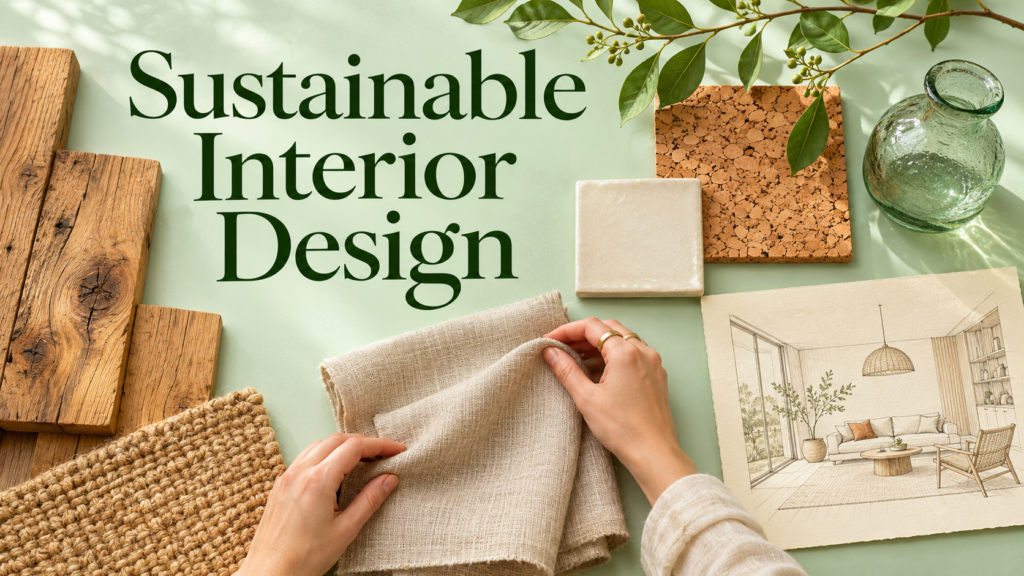
Sustainable interior design is about creating homes that look beautiful and work well while using fewer resources, producing less waste and supporting healthier indoor environments. It covers everything from the furniture you buy and the paint on your walls to how you heat, light and insulate your home. It doesn’t mean giving up style. Many of the most characterful interiors are built around vintage finds, natural materials, craftsmanship and pieces made to last.
This guide covers sustainable interior design for UK homes: the key principles, the furniture waste problem, sustainable materials, eco-friendly paints, textiles, flooring, kitchens and bathrooms, energy efficiency, water saving, certifications, how to avoid greenwashing, current UK grants and VAT relief, and budget-friendly ways to make your home more sustainable.
Table of Contents
What Is Sustainable Interior Design?
Sustainable interior design considers the environmental and social impact of every decision across a product’s life: how it’s made, how long it lasts, how it affects your health and what happens to it at the end.
Key Principles
| Principle | What It Means |
|---|---|
| Reduce | Buy less, buy better |
| Reuse | Choose vintage, second-hand and reclaimed items |
| Repair | Fix, reupholster and refinish rather than replace |
| Recycle | Choose recycled materials; recycle at end of life |
| Responsible sourcing | Certified, traceable, ethically made products |
| Longevity | Timeless design and durable materials |
| Healthy indoor air | Low-VOC paints, natural finishes |
| Energy efficiency | Insulation, LED lighting, efficient heating |
| Local | Support local makers; reduce transport emissions |
The Furniture Waste Problem
“Fast furniture” is a growing environmental issue. One waste company’s survey found that a quarter of UK adults replace a piece of their furniture at least once a year and estimates that around 670,000 tonnes of furniture are discarded each year in the UK.
Research by Mattress Online found that an average of 22 million pieces of furniture are discarded per year in the UK, much of which goes straight to landfill.
Much of this could be reused. An earlier RSA study for Suez found that only 15% of UK furniture is reused or recycled, while half of the 1.6 million tonnes sent to landfill could be.
A Simple Tip: Keep Fire Labels
One surprising reason sofas and chairs end up in landfill is missing fire safety labels. The RSA report notes that often owners of furniture cut off the fire labels, and this means they cannot be reused by charity and other resellers. Keep fire labels on upholstered furniture so it can be resold or donated later.
Office Furniture Waste
The problem extends to workplaces too. Business Moves Group reports that every year, 1.2 million desks are thrown away in the UK. That’s coupled with 1.8 million office chairs. To put that figure in perspective, 300 tonnes of furniture are sent to landfill every working day. This is worth bearing in mind when furnishing a home office: ex-office desks and chairs are often high quality and much cheaper second-hand.
Sustainable Furniture
Buy Vintage and Second-Hand
Buying second-hand is one of the most sustainable choices you can make. Real Homes notes that if you find that you’re in need of a new piece of furniture for your home, sourcing it second-hand, as opposed to opting for a brand new model will cut down on someone else’s waste.
Where to look:
- Vintage and antique dealers
- Auction houses and online auctions
- Charity shops and furniture reuse charities
- Online marketplaces and second-hand apps
- Reclamation yards
- House clearances
- Ex-office furniture suppliers
Repair and Upcycle
- Reupholster sofas and chairs
- Re-oil, wax or refinish wooden furniture
- Replace handles and hardware
- Paint tired furniture with low-VOC paint
- Turn old curtains into cushion covers
- Repurpose items (a dresser as a TV unit, a ladder as a towel rail)
Real Homes suggests simple reuse ideas such as making cushion covers out of old curtains.
Buying New Furniture Sustainably
| Look For | Why |
|---|---|
| Solid wood | Longer lifespan, can be repaired and refinished |
| FSC or PEFC certification | Responsibly sourced wood |
| Replaceable parts | Easy repairs (cushions, covers, legs) |
| Removable, washable covers | Extend sofa life |
| Long warranties | Signal durability |
| Take-back schemes | Responsible end of life |
| Local or UK-made | Lower transport emissions |
| Modular designs | Adapt to changing needs |
| Natural fillings and fabrics | Fewer synthetic materials |
Avoid Fast Furniture
- Cheap chipboard that can’t be repaired
- Trend-led pieces you’ll tire of quickly
- Furniture with glued joints that can’t be taken apart
- Pieces with no repair or spare parts options
Sustainable Materials
| Material | Sustainable Benefits | Considerations |
|---|---|---|
| Reclaimed wood | Reuses existing timber | Check for nails, treatments |
| FSC-certified wood | Responsibly managed forests | Check certification is genuine |
| Bamboo | Fast-growing, renewable | Check processing and adhesives |
| Cork | Renewable bark harvest, insulating | Can dent |
| Linen | Low water and pesticide needs | Creases easily |
| Hemp | Fast-growing, durable | Less widely available |
| Wool | Renewable, durable, flame-resistant | Animal welfare standards |
| Organic cotton | No synthetic pesticides | Higher price |
| Recycled metal | Reduces mining | Check finishes |
| Recycled glass | Lower embodied energy | Limited products |
| Natural stone (local) | Long-lasting | Heavy; quarrying impact |
| Clay and lime | Breathable, low-impact | Specialist application |
| Rattan, cane and jute | Renewable natural fibres | Less durable in damp areas |
| Recycled plastics | Diverts waste | Mixed environmental record |
Eco-Friendly Paints and Finishes
Conventional paints can release volatile organic compounds (VOCs), which affect indoor air quality.
| Paint Type | Benefits |
|---|---|
| Low-VOC or zero-VOC paints | Better indoor air quality |
| Water-based paints | Lower odour and emissions |
| Clay paints | Breathable, natural |
| Lime paints and limewash | Breathable, suit older homes |
| Mineral/silicate paints | Durable, breathable |
| Plant-based paints | Natural ingredients |
| Natural oils and waxes | For wood finishes |
Tips
- Choose water-based paints for walls and woodwork
- Use breathable paints on older solid-walled homes
- Buy only the paint you need
- Donate leftover paint to community reuse schemes
- Recycle empty tins where possible
- Look for brands that publish full ingredient lists
Sustainable Textiles
| Textile | Best Uses |
|---|---|
| Linen | Curtains, bedding, upholstery |
| Organic cotton | Bedding, towels, cushions |
| Wool | Rugs, throws, upholstery |
| Hemp | Upholstery, curtains, rugs |
| Recycled polyester | Outdoor fabrics, cushion fillings |
| Jute and sisal | Rugs and runners |
| Deadstock fabric | Upholstery, cushions |
Textile Certifications
| Certification | What It Covers |
|---|---|
| GOTS (Global Organic Textile Standard) | Organic fibres and processing |
| OEKO-TEX Standard 100 | Tested for harmful substances |
| Responsible Wool Standard | Animal welfare and land management |
| Fairtrade | Fair pay and conditions |
Sustainable Flooring
| Flooring | Sustainability Notes |
|---|---|
| Reclaimed wood | Reuses existing materials |
| FSC-certified engineered wood | Uses less hardwood than solid boards |
| Solid wood | Long lifespan, can be sanded many times |
| Cork | Renewable, warm, quiet |
| Bamboo | Fast-growing |
| Linoleum (natural) | Made from linseed oil, cork, wood flour |
| Wool carpet | Natural, durable |
| Natural stone (local) | Long-lasting |
| Reclaimed tiles | Reuses period materials |
Tip: restore original floorboards, Victorian tiles and parquet rather than covering or replacing them.
Sustainable Kitchens and Bathrooms
Kitchens
- Keep kitchen carcasses and replace doors and worktops only
- Choose FSC-certified or reclaimed wood
- Buy energy-efficient appliances
- Choose induction hobs over gas
- Use recycled or durable worktops
- Plan recycling and composting storage
- Buy ex-display or reclaimed kitchens
Bathrooms
- Choose low-flow taps and showerheads
- Fit dual-flush toilets
- Keep and refinish good-quality baths
- Use durable, long-lasting tiles
- Choose low-VOC sealants and finishes
- Ensure good ventilation to prevent mould
Energy-Efficient Interiors
Energy use in the home has a huge environmental impact, and interior choices can help reduce it.
Energy-Saving Design Ideas
| Measure | Benefit |
|---|---|
| LED lighting | Uses much less energy than old bulbs |
| Smart controls and dimmers | Reduce wasted energy |
| Thermal curtains and blinds | Reduce heat loss |
| Draught-proofing | Keeps heat in |
| Rugs on hard floors | Add warmth |
| Insulation (loft, walls, floors) | Major heat savings |
| Secondary or double glazing | Reduces heat loss |
| Efficient heating systems | Lower running costs and emissions |
| Heat pumps | Low-carbon heating |
| Solar panels | Renewable electricity |
Insulation Savings
Insulation is one of the most effective measures. Checkatrade cites Energy Saving Trust figures showing that for an average semi-detached home, installing loft insulation in an uninsulated loft with 270mm insulation can save homeowners up to £230 on their annual energy bills, while cavity wall insulation can result in savings of approximately £240 per year.
Grants and VAT Relief for Sustainable Upgrades
Boiler Upgrade Scheme
The Boiler Upgrade Scheme helps homeowners switch to heat pumps. The government’s Warm Homes Plan includes £2.7bn will be invested into the existing boiler upgrade scheme, which offers £7,500 towards the upfront cost of installing hydronic heat pumps and grants of up to £5,000 for biomass boilers.
The scheme survived the latest Budget. PV Magazine reports that the UK government has retained the boiler upgrade scheme (BUS) despite widespread speculation the heat pump subsidy program was set to be scrapped, although the total budget for the program has been cut by around GBP 700 million.
Eligibility conditions apply. Checkatrade notes you’ll need a valid EPC with no outstanding loft or cavity wall insulation recommendations, and that most new builds are not eligible.
0% VAT on Energy-Saving Materials
Installing qualifying energy-saving materials currently attracts 0% VAT. This includes heat pumps, solar panels, electrical storage batteries, as well as insulation and draught-proofing.
This relief is ending. The MCS Foundation notes that from 1 April 2022 until 31 March 2027 VAT on installing energy-saving materials (ESMs) in residential properties will be 0% in Great Britain. Following the latest Budget, Selectra reports the Treasury describes it as a return to the reduced rate “as planned”, from 1 April 2027, for energy-saving materials installed in homes and charity buildings.
The relief only covers professional installation. Panels or a battery bought from a retailer and fitted by the owner are standard-rated at 20%, now and after April, according to HMRC’s guidance on energy-saving materials.
Insulation Schemes
The Great British Insulation Scheme and ECO4 provide free or subsidised insulation for eligible households. Checkatrade explains that the Great British Insulation Scheme was set up to provide free or subsidised insulation to help households reduce their energy bills.
Grants Summary
| Scheme | What It Offers |
|---|---|
| Boiler Upgrade Scheme | £7,500 towards heat pumps; up to £5,000 for biomass boilers |
| 0% VAT on energy-saving materials | Until 31 March 2027, then 5% |
| Great British Insulation Scheme / ECO4 | Free or subsidised insulation for eligible households |
| Warm Homes Plan | Wider funding for home upgrades |
Grant rules and funding can change, so check GOV.UK and Ofgem for the latest details before planning work.
Water-Saving Ideas
- Low-flow showerheads and aerated taps
- Dual-flush toilets
- Water-efficient dishwashers and washing machines
- Water butts for garden use
- Fixing dripping taps promptly
- Choosing showers over baths
Healthy Homes and Indoor Air Quality
Sustainable design also considers health:
- Low-VOC paints, adhesives and sealants
- Natural fibres and untreated materials
- Good ventilation and extractor fans
- Houseplants (for wellbeing and biophilic design)
- Avoid synthetic air fresheners
- Breathable finishes to prevent damp and mould
Biophilic Design
Biophilic design brings nature indoors:
- Natural light and views
- Plants and living walls
- Natural materials (wood, stone, linen, clay)
- Organic shapes and nature-inspired patterns
- Earthy colour palettes
- Natural ventilation
Avoiding Greenwashing
Not every “eco” product is genuinely sustainable. Watch out for:
| Red Flag | What to Ask |
|---|---|
| Vague claims (“eco-friendly”, “green”) | What specifically makes it sustainable? |
| No certifications | Is it FSC, GOTS, OEKO-TEX certified? |
| “Natural” but heavily processed | How is it made? |
| Recycled content not quantified | What percentage is recycled? |
| No information on origin | Where and how is it made? |
| Cheap “sustainable” fast furniture | How long will it last? |
The most sustainable product is often the one you already own, followed by a second-hand alternative.
Sustainable Interior Design on a Budget
- Use what you have: rearrange furniture before buying new
- Shop second-hand: vintage furniture is often cheaper and better made
- Repair: reupholster, refinish, replace handles
- Repaint: low-VOC paint transforms rooms affordably
- Swap textiles: linen cushions, wool throws, natural rugs
- Switch to LED bulbs: cheap and effective
- Draught-proof: seal gaps around doors and windows
- Add thermal curtains: keep heat in during winter
- Bring in plants: affordable biophilic design
- Donate or sell unwanted items: keep them out of landfill
Sustainable Design Room by Room
| Room | Sustainable Ideas |
|---|---|
| Living room | Vintage furniture, wool rug, linen curtains, LED lamps |
| Kitchen | Replace doors not carcasses, induction hob, FSC wood worktops |
| Bedroom | Organic bedding, wool carpet, solid wood furniture |
| Bathroom | Low-flow fittings, durable tiles, good ventilation |
| Home office | Ex-office furniture, LED desk lamp, plants |
| Hallway | Reclaimed tiles, natural fibre runner, upcycled bench |
| Children’s rooms | Second-hand furniture, low-VOC paint, natural textiles |
Common Mistakes
| Mistake | Better Approach |
|---|---|
| Replacing everything at once | Keep, repair and reuse |
| Buying cheap trend-led furniture | Choose durable, timeless pieces |
| Cutting off fire labels | Keep labels so furniture can be resold |
| Ignoring insulation | Fix heat loss first |
| Trusting vague eco claims | Look for certifications |
| Using plastic-based paints on old walls | Choose breathable paints |
| Throwing away usable furniture | Donate, sell or recycle |
| Missing grant deadlines | Check VAT relief before 31 March 2027 |
Final Thoughts
Sustainable interior design is about choosing well, keeping things longer and making your home healthier and more energy efficient. With around 22 million pieces of furniture thrown away in the UK every year, the biggest difference you can make is to buy less, buy second-hand, repair what you have and keep fire labels on upholstered furniture so it can be reused. Choose natural, certified and durable materials, low-VOC paints, natural fibres and LED lighting, and tackle energy efficiency through insulation, draught-proofing and efficient heating. The Boiler Upgrade Scheme still offers £7,500 towards heat pumps, and 0% VAT on qualifying energy-saving installations runs until 31 March 2027 before returning to 5%.
Frequently Asked Questions
1. What is sustainable interior design?
It’s an approach that reduces waste and environmental impact by reusing, repairing and choosing durable, natural, responsibly sourced and energy-efficient materials.
2. How can I make my home more sustainable on a budget?
Shop second-hand, repair and upcycle furniture, switch to LED bulbs, use low-VOC paint and draught-proof doors and windows.
3. Is there still 0% VAT on energy-saving materials in the UK?
Yes, professionally installed qualifying materials such as insulation, solar panels and heat pumps have 0% VAT until 31 March 2027, after which the rate returns to 5%.