Choosing the right rug size is one of the most important decorating decisions you can make, and one of the easiest to get wrong. A rug that’s too small makes a room feel disjointed and furniture look like it’s floating, while one that’s too large can overwhelm a space or creep under doors. Get it right and a rug pulls the whole room together, defines zones, adds warmth and softens sound.
This guide covers standard UK rug sizes, how to measure, placement rules for living rooms, dining rooms, bedrooms, hallways, kitchens and open-plan spaces, round and runner rugs, rug materials and construction, underlays, UK prices and the most common rug sizing mistakes.
Table of Contents
Why Rug Size Matters
Rug size changes how a room looks and feels. Rug Love explains that a rug that’s too small can make your space feel disjointed, while an oversized one may overwhelm the layout.
The right rug:
- Anchors furniture into a group
- Defines zones in open-plan spaces
- Makes rooms feel bigger and more finished
- Adds warmth and softness underfoot
- Reduces echo on hard floors
- Protects floors from wear
The Golden Rule: When in Doubt, Go Bigger
Most designers agree that a rug slightly too large is better than one too small. Rug Love advises: When unsure, go larger — it makes spaces feel bigger.
Standard UK Rug Sizes
| Size (cm) | Approx. Size (ft) | Typical Use |
|---|---|---|
| 60 × 110 | 2′ × 3’7″ | Doormats, bathroom, bedside |
| 80 × 150 | 2’7″ × 5′ | Bedside, small spaces, under small coffee tables |
| 120 × 170 | 4′ × 5’7″ | Small living rooms, under coffee tables, beside double beds |
| 160 × 230 | 5’3″ × 7’7″ | Most UK living rooms, under double beds, 4-seater dining tables |
| 200 × 290/300 | 6’7″ × 9’6″/9’10” | Larger living rooms, king beds, 6–8 seater dining tables |
| 240 × 330/340 | 7’10” × 10’10” | Large living rooms, open-plan spaces |
| 300 × 400 | 9’10” × 13’1″ | Very large rooms, all-legs-on layouts |
| 60 × 180/240 | Runner | Hallways, kitchens, beside beds |
| 80 × 300 | Runner | Long hallways, landings |
| 120/160/200 round | Round | Round tables, small rooms, entrances |
Rug Love describes the smaller end: 80 x 150 cm – Ideal for compact areas, hallways, or under small coffee tables. For larger rooms, it notes that commonly measuring 160 cm x 230 cm or 200 cm x 300 cm, large rugs are suited for most average-sized living rooms. They provide ample coverage and can fit under all the front legs of your living room furniture.
The Most Popular UK Size
160 × 230cm is the most common rug size in British homes. Fableroom explains that 160 × 230 cm is the most popular size in British homes. It suits a standard terrace or semi-detached living room and works well with the front-legs-on placement style.
How to Measure for a Rug
- Measure the room: length and width, noting doors, radiators and fireplaces
- Plan your furniture layout: decide where sofas, chairs, tables and beds will go
- Measure the furniture zone: rather than the whole room
- Choose a placement style: all legs on, front legs on or floating
- Leave a floor border: usually around 20–45cm of floor between rug and walls in most rooms
- Mark it out: use masking tape or newspaper to test the size before buying
- Check door clearance: make sure doors can open over the rug
Measuring the furniture arrangement matters more than room size. One guide advises that you measure the furniture arrangement rather than relying only on the room’s floor area. Swan Street recommends you use tape to test the layout before buying.
Living Room Rug Size Guide
Three Main Placement Options
| Placement | How It Works | Typical Rug Size | Best For |
|---|---|---|---|
| All legs on | All furniture sits fully on the rug | 200 × 290cm or larger | Large living rooms |
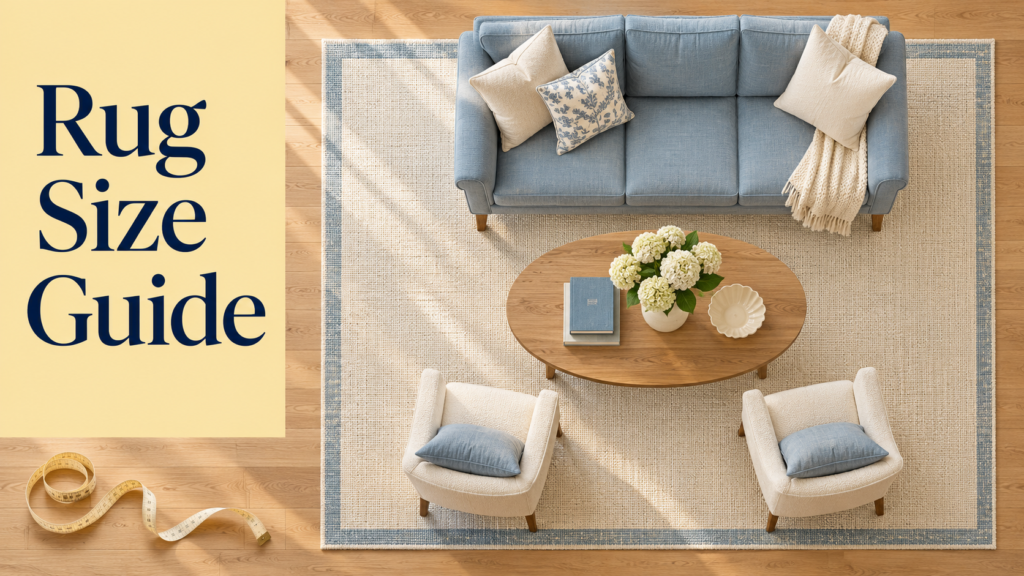
| Front legs on | Front legs of sofas and chairs sit on the rug | 160 × 230cm–200 × 290cm | Most UK living rooms |
| Floating/coffee table only | Rug sits under the coffee table, no furniture on it | 120 × 170cm | Very small rooms |
Rug Love summarises the options: All furniture on: Best for large rooms; place sofas, chairs, and tables entirely on the rug. Front legs only: Ideal for mid-size spaces; keeps balance without overpowering. And Coffee table only: For compact rooms, centre the rug under the table to define the area.
Front Legs On: The UK Favourite
The front-legs-on layout is the most popular in British homes. Fableroom says that the front-legs-on approach tends to work best in standard UK living rooms, where room scale is often more modest than in American or Continental European homes.
Make sure the legs sit properly on the rug. Icon by Design advises that for balanced living room rug placement, make sure the rug sits at least 10cm under the front legs of your sofas and chairs.
Argos suggests this layout for smaller rooms too: If you’ve got a smaller room where furniture is up against the walls, opt for a rug that sits underneath the front two legs of your sofas.
Living Room Rug Size by Room Width
| Room Width | Recommended Layout | Typical Rug Size |
|---|---|---|
| Under 3m | Front legs on or floating | 120 × 170cm–160 × 230cm |
| 3–4m | Front legs on | 160 × 230cm |
| 4m+ | All legs on | 200 × 290cm+ |
Fableroom’s guide matches these widths, recommending all legs on the rug at 200 × 290 cm+ for large rooms (4m+ wide), and front legs on rug at 160 × 230 cm for medium rooms (3–4m wide).
Large Seating Arrangements
Very large sofas need bigger rugs. One rug guide recommends Three seater plus two armchairs250 x 350 cmAll front legs on it, with floor visible around the edge, and for a large corner arrangement300 x 400 cm, from which size a made-to-measure rug pays off.
Rug Width vs Sofa Width
As a general rule, the rug should be wider than the sofa, ideally extending at least 15–20cm beyond each end. A rug narrower than the sofa looks too small.
Dining Room Rug Size Guide
Dining rugs need to be big enough for chairs to stay on the rug when pulled out. Icon by Design advises: For the best dining room rug size, allow at least 60cm of rug to extend beyond every edge of the table.
| Table Size | Recommended Rug Size |
|---|---|
| 4-seater | 160 × 230cm |
| 6–8 seater | 200 × 290cm |
| 8–10 seater | 240 × 330cm or larger |
| Round table (4-seater) | 160–200cm round |
| Round table (6-seater) | 200–240cm round |
House of Isabella recommends Dining Room | 160×230 cm (4-seater), 200×290 cm (6–8 seater).
Dining Rug Tips
- Match rug shape to table shape. Rug Love notes rectangular rugs pair with rectangular tables; round tables suit round rugs.
- Choose low-pile or flatweave rugs so chairs slide easily. Rug Love recommends Flat-woven rugs: These are ideal for dining rooms as they allow easy chair movement and are easier to clean.
- Choose stain-resistant materials or washable rugs for families
- Keep all chair legs on the rug for safety
Wayfair recommends all legs on in dining rooms: We recommend sticking with all legs on the rug for this room – for safety’s sake.
Bedroom Rug Size Guide
Placement Options
| Layout | Description |
|---|---|
| Under the bed | Large rug under the lower two-thirds of the bed, extending either side |
| Runners either side | Two runners along each side of the bed |
| Bedside rugs | Small rugs on each side |
| Foot of the bed | Rug at the end of the bed |
Bedroom Rug Sizes by Bed Size
| Bed Size | Rug Under Bed |
|---|---|
| Single | 120 × 170cm |
| Double | 160 × 230cm |
| King | 200 × 290cm |
| Super king | 240 × 330cm |
House of Isabella recommends Bedroom | 120×170 cm (double), 160×230 cm (king), runners, which suits rugs placed across the lower part of the bed. A larger rug gives more soft floor on either side.
Bedroom Rug Tips
- Extend the rug roughly 45–60cm beyond each side of the bed so your feet land on it
- Start the rug just in front of bedside tables or include them
- Use runners for narrow bedrooms
- Choose soft wool or high-pile rugs for comfort
Hallway and Runner Rug Size Guide
| Hallway Length | Runner Size |
|---|---|
| Short hallway | 60 × 180cm |
| Medium hallway | 70 × 240cm |
| Long hallway | 80 × 300cm or longer |
House of Isabella lists Hallway | 60×180 cm, 80×300 cm runner.
Runner Tips
- Leave around 10–15cm of floor on each side of the runner
- Leave space at each end
- Check the front door opens over the rug
- Choose hard-wearing, low-pile or flatweave materials
- Use a non-slip underlay
Swan Street advises that you check hallway door clearance.
Kitchen Rug Size Guide
- Runners in front of sink and worktops (60 × 180cm or 80 × 240cm)
- Small rugs in front of the hob or sink
- Washable rugs for easy cleaning
- Flatweave or low-pile rugs
- Non-slip underlays essential
Open-Plan Rug Ideas
Rugs are ideal for defining zones in open-plan spaces. Rug Love notes that in open-plan homes, rugs separate dining and seating areas.
| Zone | Rug Approach |
|---|---|
| Living area | Large rug under seating (front legs or all legs on) |
| Dining area | Rug extending 60cm beyond table |
| Kitchen | Runner or washable rug |
| Reading corner | Small round or square rug |
Open-Plan Tips
- Use rugs in coordinating colours or materials
- Don’t use identical rugs in each zone; vary size and pattern
- Leave floor space between rugs
- Keep walkways clear
Round and Other Rug Shapes
| Shape | Best For |
|---|---|
| Rectangle | Most rooms, sofas and rectangular tables |
| Round | Round dining tables, entrances, nurseries, small rooms |
| Square | Square rooms and tables |
| Oval | Oval tables, softening rooms |
| Runner | Hallways, kitchens, beside beds |
| Irregular/organic | Contemporary interiors |
Round rugs soften rooms and work well in small spaces. Icon by Design notes that round rugs paired with round tables create a harmonious look, while round rugs in small spaces help soften the room’s layout.
Rug Materials
| Material | Pros | Cons | Best For |
|---|---|---|---|
| Wool | Durable, warm, naturally stain-resistant | Can shed initially | Living rooms, bedrooms |
| Cotton | Washable, affordable | Less durable | Bedrooms, children’s rooms |
| Jute/sisal | Natural texture, eco-friendly | Hard to clean; rough | Living rooms, layering |
| Viscose | Silky sheen, affordable | Marks easily; poor durability | Low-traffic rooms |
| Polypropylene | Cheap, stain-resistant, outdoor-friendly | Less luxurious | Kitchens, outdoors, families |
| Polyester | Soft, colourful | Can flatten | Bedrooms |
| Silk/bamboo silk | Luxurious sheen | Expensive, delicate | Low-traffic luxury rooms |
| Washable rugs | Machine washable | Thinner | Kitchens, pets, children |
Rug Construction
| Construction | Description | Durability | Price |
|---|---|---|---|
| Hand-knotted | Knots tied by hand on a loom | Can last decades | Highest |
| Hand-tufted | Yarn punched into backing | Good | Mid to high |
| Hand-loomed | Woven on a hand loom | Moderate | Mid |
| Flatweave (kilim, dhurrie) | Woven without pile | Good | Low to mid |
| Machine-made/power-loomed | Industrially woven | Shorter lifespan | Lowest |
Hand-tufted rugs are a popular middle ground. Fableroom explains that hand-tufted rugs are made by punching yarn into a fabric backing with a tufting tool, then securing it with a secondary backing. The result is a soft, plush rug with beautiful texture at a more accessible price point.
Lifespan varies widely. Rug Love notes that handmade rugs can last over 100 years, while machine-made rugs typically last 5-20 years.
Hand-Knotted vs Machine-Made Value
Hand-knotted rugs cost more upfront, but last much longer. One rug brand argues that per year of use, a $3,000 hand-knotted rug kept for thirty years costs less than a $400 machine-made rug replaced every four.
Pile Height
| Pile | Height | Best For |
|---|---|---|
| Flatweave | Very low | Dining rooms, hallways, kitchens |
| Low pile | Under 1cm | Busy areas, under doors |
| Medium pile | 1–2cm | Living rooms |
| High pile/shaggy | Over 2cm | Bedrooms, cosy living spaces |
Tip: check that doors can open over higher-pile rugs.
Rug Prices in the UK
| Rug Type | Example Price |
|---|---|
| Hand-tufted wool rug (120 × 170cm) | Around £150–£210 |
| Hand-tufted wool rug (200 × 300cm) | Around £560–£770 |
| Handmade wool rug (200 × 300cm) | Around £900 |
| Hand-knotted wool rug (200 × 300cm) | Around £1,000+ |
| Bespoke luxury hand-knotted rug | Over £1,000 per m² |
Example prices include a Hand-Woven Wool rug at 120 × 170 cm reduced to £152.92 from £209.99, and a Sommerallee Troy Hand Tufted Wool Grey Rug 200 x 300 Grey at £769.99. Hand-knotted rugs cost more: PriceRunner lists the Ebern Designs Kusai Hand Knotted Wool Nature Rug 200 x 300 cm at £1,049.99.
Luxury bespoke rugs are far pricier. Designer Deirdre Dyson notes her bespoke hand-knotted rugs start at over a thousand pounds per square metre.
Machine-made and synthetic rugs are much cheaper, often under £100 for medium sizes. Prices vary widely by retailer, material and design.
What Affects Rug Price?
- Size
- Material (wool, silk, synthetic)
- Construction (hand-knotted, tufted, machine-made)
- Knot density
- Brand and designer
- Bespoke sizing
Knot density is a sign of quality. Edward Martin notes that one of the clearest indicators of craftsmanship is knot density, the number of knots per square inch. The higher the density, the more refined the pattern, the sharper the detail, and the longer it takes to complete.
Rug Underlays
A good underlay:
- Stops rugs slipping
- Protects floors
- Adds cushioning
- Extends rug life
- Reduces noise
Many retailers recommend anti-slip underlays, especially on hard floors. Choose an underlay slightly smaller than the rug so it doesn’t show.
Layering Rugs
Layering adds texture and can make a small rug work in a larger space:
- Place a smaller patterned rug over a large jute or sisal rug
- Layer a sheepskin over a wool rug
- Use a large neutral base with a colourful top rug
- Keep the base rug flat and low-pile
Rug Care
- Vacuum regularly (use a low setting or turn off the beater bar for delicate rugs)
- Rotate every 6–12 months for even wear
- Blot spills immediately
- Professionally clean wool and handmade rugs
- Keep out of strong direct sunlight to prevent fading
- Shake out small rugs outdoors
Common Rug Sizing Mistakes
| Mistake | Better Approach |
|---|---|
| Buying a rug that’s too small | Size up; aim for front legs on |
| Rug narrower than the sofa | Extend beyond sofa ends |
| Dining rug too small for chairs | Allow 60cm beyond the table |
| Bedroom rug that doesn’t reach either side | Extend beyond the sides of the bed |
| Rug blocking doors | Check door clearance |
| No floor border | Leave a margin around the rug |
| High-pile rug in dining rooms | Use flatweave or low pile |
| Viscose rug in busy areas | Choose wool or polypropylene |
| No underlay | Use non-slip underlay |
| Not testing the size | Mark it out with tape first |
Rug Size Quick Reference
| Room | Recommended Sizes |
|---|---|
| Living room | 120 × 170cm, 160 × 230cm, 200 × 290cm |
| Dining room | 160 × 230cm (4-seater), 200 × 290cm (6–8 seater) |
| Bedroom | 120 × 170cm (double), 160 × 230cm (king), runners |
| Hallway | 60 × 180cm, 80 × 300cm runner |
These sizes match House of Isabella’s recommendations: Living Room | 120×170 cm, 160×230 cm, 200×290 cm.
Final Thoughts
The right rug size anchors furniture, defines zones and makes rooms feel bigger and more finished. For most UK living rooms, a 160 × 230cm rug with the front legs of sofas and chairs on it works best, while larger rooms suit 200 × 290cm rugs or bigger with all legs on. Dining rugs should extend at least 60cm beyond every edge of the table, and bedroom rugs should reach beyond both sides of the bed. Measure your furniture layout, test with tape, and size up when in doubt. Choose wool for durability, flatweaves for dining rooms and hallways, and washable or synthetic rugs for kitchens and busy family homes, and always use a non-slip underlay.
Frequently Asked Questions
1. What is the most common rug size in the UK?
160 × 230cm is the most popular size for UK living rooms, especially with the front legs of sofas on the rug.
2. What size rug do I need for a dining table?
Choose a rug that extends at least 60cm beyond every edge of the table, such as 160 × 230cm for 4 seats or 200 × 290cm for 6–8 seats.
3. Should the sofa be on the rug?
Ideally, at least the front legs of your sofa and chairs should sit on the rug, by around 10cm or more.