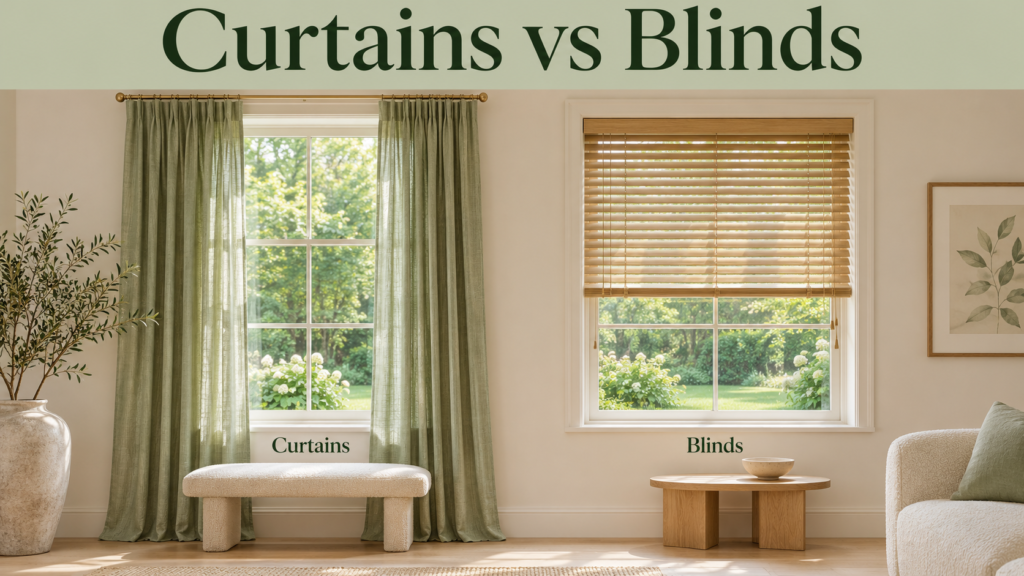
Choosing between curtains and blinds is one of the most common window decisions in UK homes. Both control light and privacy, both can help keep heat in, and both come in a huge range of styles and prices. They work very differently, though. Curtains bring softness, warmth and drama, while blinds are neat, compact and offer precise light control. In many rooms, the best answer is a combination of the two.
This guide compares curtains and blinds in detail: pros and cons, types, light control and blackout, privacy, energy efficiency and heat loss, cleaning, child safety, room-by-room advice, layering, shutters as an alternative, measuring tips and UK costs.
Table of Contents
Curtains vs Blinds: Quick Comparison
| Factor | Curtains | Blinds |
|---|---|---|
| Look | Soft, cosy, decorative | Neat, tailored, minimal |
| Light control | Open or closed (blackout available) | Precise (slats, top-down/bottom-up, day-night) |
| Privacy | Good when closed; sheers for daytime | Very good; adjustable |
| Insulation | Very good with thermal lining | Good with thermal or honeycomb blinds |
| Space needed | Stack-back space either side; floor length | Fits within or above window recess |
| Radiators under windows | Can block heat if long | Ideal |
| Cleaning | Wash or dry clean | Wipe or dust; some washable |
| Noise reduction | Better (heavier fabric) | Moderate |
| Cost | Wide range; made-to-measure can be expensive | Generally cheaper, especially rollers |
| Best for | Living rooms, bedrooms, large windows | Kitchens, bathrooms, home offices, small windows |
Blinds Direct puts it neatly: the curtains vs blinds decision is less about “which is better” and more about “what problem are you trying to solve?”
Pros and Cons of Curtains
Pros
- Add softness, warmth and texture
- Make windows look larger when hung wide and high
- Excellent insulation with thermal or interlined linings
- Good sound absorption
- Huge choice of fabrics, colours and patterns
- Can hide less attractive windows or frames
- Blackout lining available
Curtains are particularly good where atmosphere matters. Blinds Direct notes that curtains are often most effective in spaces where atmosphere matters more than precision light control, such as living rooms where complete blackout is not always essential.
Cons
- Need space either side of the window
- Long curtains can block radiators
- Not ideal in kitchens and bathrooms
- Harder to clean
- Can be expensive when made to measure
- Less precise light control
Pros and Cons of Blinds
Pros
- Neat, space-saving and practical
- Precise light control
- Ideal over radiators, sinks and worktops
- Easier to clean (many types)
- Moisture-resistant options for kitchens and bathrooms
- Affordable, especially roller blinds
- Perfect fit options for tilt-and-turn and uPVC windows
Cons
- Can feel less cosy on their own
- Some types gather dust (Venetians)
- Light gaps around the edges with recess-fitted blinds
- Less sound absorption
- Cords and chains need child safety devices
Types of Curtains
| Type | Features | Best For |
|---|---|---|
| Pencil pleat | Classic gathered heading | Traditional rooms, tracks or poles |
| Eyelet | Rings punched through fabric; modern | Contemporary rooms, poles |
| Pinch pleat | Tailored, formal | Period homes, luxury schemes |
| Wave | Soft, even S-shaped folds on a track | Modern homes, large windows |
| Tab top | Fabric loops | Casual, cottage style |
| Sheer/voile | Lightweight, filters light | Daytime privacy, layering |
| Café curtains | Cover the lower half | Kitchens, period homes |
| Blackout curtains | Lined to block light | Bedrooms, nurseries |
| Thermal/interlined curtains | Extra insulating layers | Living rooms, older homes |
Curtain Lengths
| Length | Look |
|---|---|
| Sill length | Neat, practical (kitchens, small windows) |
| Below sill | Covers radiators partly; practical |
| Floor length | Elegant, makes ceilings look higher |
| Puddled | Luxurious, romantic |
Types of Blinds
| Blind Type | Features | Best For |
|---|---|---|
| Roller | Simple, affordable, wide choice | Most rooms |
| Roman | Fabric folds; soft look | Living rooms, bedrooms |
| Venetian (aluminium, wood, faux wood) | Tilting slats | Kitchens, bathrooms, offices |
| Vertical | Slats hang vertically | Patio doors, large windows |
| Pleated | Folded fabric; top-down/bottom-up options | Conservatories, awkward windows |
| Honeycomb/cellular | Air pockets for insulation | Energy efficiency |
| Day and night (vision) | Alternating sheer and solid bands | Modern rooms |
| Blackout | Blocks light | Bedrooms, nurseries |
| Perfect fit | Clip into uPVC window frames, no drilling | Tilt-and-turn windows |
| Skylight/roof blinds | Fit rooflights | Lofts, extensions |
| Motorised/smart blinds | Remote or app control | Hard-to-reach windows |
Light Control and Blackout
| Need | Best Choice |
|---|---|
| Total blackout | Blackout curtains plus blackout blind |
| Adjustable light | Venetian, day and night or pleated blinds |
| Soft filtered light | Sheers or light-filtering blinds |
| Privacy with daylight | Top-down/bottom-up pleated blinds, voiles |
| Glare control for screens | Venetian or roller blinds |
Tip: recess-fitted blinds leave small light gaps at the sides. For full blackout, fit blinds outside the recess or combine with curtains.
Energy Efficiency: Do Curtains or Blinds Keep Heat In?
Windows lose a lot of heat. Selectra notes that the Energy Saving Trust puts the share of heat that escapes through the windows at around 18%, adding that windows are the only leak you can do something about tonight without builders.
How Much Heat Can They Save?
Both curtains and blinds help, and the results depend heavily on the product and fit.
| Window Covering | Reported Heat Loss Reduction |
|---|---|
| Conventional curtains | Around 10% |
| High-quality thermal curtains (fully drawn, close fitting) | 25%–33% |
| Blinds generally (BBSA research) | Up to 33% |
| Interlined Roman blinds | Up to 21% |
| Energy-saving honeycomb pleated blinds | Up to 33% |
| Best-performing thermal blinds (Hillarys claim) | Up to 55% |
One evidence review found that conventional curtains typically reduce heat loss by around 10% while high-quality thermal curtains, when fully drawn and fitted close to the wall, can reduce heat loss by 25% to 33%.
For blinds, research conducted and funded by the British Blind and Shutter Association (BBSA), as part of their Blinds Make Better campaign, shows that blinds can reduce heat loss through windows by up to 33%.
Hillarys says interlined Roman blinds are another option, cutting heat loss by up to 21%, perfect for rooms with radiators under windows, as they won’t block the heat like curtains would. Its best thermal blinds reduce heat loss through your windows by up to 55%, although that figure comes from a manufacturer.
Curtains, Blinds and Radiators
If you have a radiator under the window, long curtains can trap heat behind them and send it out through the glass. Blinds or sill-length curtains are a better choice here.
Energy Tips
- Close curtains and blinds at dusk in winter
- Open them on sunny winter days to let in solar heat
- Use thermal linings or interlining
- Choose honeycomb or thermal blinds
- Layer blinds and curtains for maximum insulation
- Fit curtains close to the wall and extend beyond the window
- In summer, close them during hot sunny periods to keep rooms cool
Groundwork advises you to be sure to close thermal curtains when it gets dark to minimise heat loss through your windows.
The Energy Saving Trust’s advice is clear: ‘When buying new blinds, look out for hollow, thick or thermally lined options as these will have the best insulating properties,’
Remember that window coverings are not a substitute for better glazing, insulation or draught-proofing. Groundwork notes that fitting draught proofing around all the windows and doors in a typical home can save around £40 in energy bills each year.
Curtains vs Blinds Room by Room
| Room | Best Option | Why |
|---|---|---|
| Living room | Curtains, Roman blinds or both | Softness, warmth, insulation |
| Bedroom | Blackout blinds plus curtains | Blackout and cosiness |
| Nursery | Blackout blinds with cordless operation plus curtains | Sleep and child safety |
| Kitchen | Roller, Venetian or faux wood blinds | Practical near sinks and hobs |
| Bathroom | PVC or faux wood blinds, moisture-resistant rollers | Moisture resistance |
| Home office | Venetian or roller blinds | Glare control on screens |
| Dining room | Curtains or Roman blinds | Atmosphere |
| Conservatory | Pleated or roof blinds | Heat and glare control |
| Patio doors | Vertical blinds or curtains on a track | Easy access |
| Loft/skylights | Roof blinds | Fit angled windows |
| Bay windows | Curtains on a bay track or blinds per pane | Flexibility |
| Hallway/stairs | Roller or Roman blinds | Space saving |
Living Rooms
Curtains create warmth and atmosphere, while Roman blinds work well for smaller windows or where radiators sit underneath. Layer a Roman blind with dress curtains for a luxurious look.
Bedrooms
For the best sleep, combine a blackout roller blind with lined curtains. The blind blocks light, while the curtains block edge light and add warmth.
Kitchens and Bathrooms
Blinds are usually best because they keep fabric away from heat, steam and water. Choose moisture-resistant materials such as PVC, faux wood or aluminium.
Home Offices
Blinds offer the precise light control needed to reduce screen glare. Venetian blinds let you angle light away from your monitor.
Layering Curtains and Blinds
Layering gives you the best of both:
| Combination | Benefits |
|---|---|
| Blackout roller blind plus curtains | Total darkness, insulation |
| Roman blind plus dress curtains | Luxurious, layered look |
| Voile plus curtains | Daytime privacy plus evening warmth |
| Venetian blind plus curtains | Light control plus softness |
| Day and night blind plus curtains | Flexibility and warmth |
Tip: dress curtains are decorative curtains that stay open. They add colour and softness without needing to cover the window fully.
Shutters: The Third Option
Plantation shutters are increasingly popular in UK homes.
Pros of Shutters
- Durable and long-lasting
- Excellent light and privacy control
- Easy to clean
- Add a tailored, architectural look
- Suit period and modern homes
Cons
- Expensive
- Permanent framework
- Less soft than curtains
Checkatrade notes that shutters cost more than many curtains or blinds, but they’re hard-wearing, easy to clean and can be made to fit awkward window shapes. It estimates the cost of shutters for a 3-bedroom house (supply + install): around £5,000, based on an average of 12 windows.
Child Safety: Blind Cords and Chains
Looped blind cords and chains pose a strangulation risk to young children. In the UK and EU, blinds must meet safety standards (BS EN 13120) that require built-in safety features. Many blinds come with tensioners and breakaway devices to ensure child safety.
Blind Safety Tips
- Choose cordless or motorised blinds in children’s rooms
- Fit cord tidies or tensioners to the wall
- Keep cords and chains out of reach
- Don’t place cots, beds or furniture near blind cords
- Check older blinds for missing safety devices
Cleaning and Maintenance
| Window Covering | How to Clean |
|---|---|
| Curtains | Vacuum regularly; wash or dry clean as labelled |
| Roller blinds | Wipe with a damp cloth; vacuum |
| Venetian blinds | Dust slats; wipe with cloth |
| Vertical blinds | Dust or wipe; some washable slats |
| Roman blinds | Vacuum; spot clean; some removable fabrics |
| PVC blinds | Wipe clean |
| Shutters | Dust and wipe |
Measuring for Curtains and Blinds
Curtains
- Decide on a pole or track
- Fit the pole 10–15cm above the window (higher for taller-looking ceilings)
- Extend the pole 15–20cm beyond each side of the window
- Measure the pole width (not the window) for curtain width
- Measure the drop from the pole or track to where you want the curtains to finish
- Allow for heading style fullness
Blinds
| Fitting | How to Measure |
|---|---|
| Inside the recess | Measure the recess width at the top, middle and bottom; use the narrowest |
| Outside the recess | Add around 5–10cm overlap to each side |
| Perfect fit | Measure the glass and frame as instructed by the supplier |
Tip: check that blinds won’t hit window handles, and that windows can still open.
Curtain and Blind Costs in the UK
Ready-Made vs Made-to-Measure
Ready-made curtains are cheapest. One guide notes that ready-made curtains from Dunelm (from £20 per pair), IKEA (from £15 per pair), and John Lewis (from £40 per pair) are the fastest and most affordable route.
Made-to-measure costs more. The same guide notes that John Lewis made-to-measure starts from approximately £150 per window. Online specialists like Blinds2Go and Curtains2Go offer made-to-measure from around £80 per window.
Blind prices vary enormously. English Blinds says blinds cost anything from as little as £5 for a very small readymade roller blind up to potentially several thousand pounds for a designer Roman blind.
Typical Costs
| Item | Typical Cost |
|---|---|
| Ready-made curtains (pair) | From £15–£40 |
| Made-to-measure curtains (per window) | From around £80–£150+ |
| Professional made-to-measure curtain projects | £615–£1,658 |
| Ready-made roller blind | From around £5–£30 |
| Made-to-measure roller blind | Around £30–£150 |
| Made-to-measure Roman blind | Around £100–£400+ |
| Thermal blinds | From under £10 (budget ranges) |
| Blind fitting | £55–£125 |
| Plantation shutters (3-bed house, 12 windows) | Around £5,000 |
| Manual roller shutters (per window) | £500–£1,500 |
For professional made-to-measure curtains, Checkatrade says you can expect to pay between £615 to £1658. Fitting blinds professionally typically ranges from £55-£125 for fitting, though many people fit blinds themselves. Ideal Home notes that some thermal blinds at Blinds 2go retail for less than £10 per blind. Roller and Roman blind ranges above are approximate.
Value for Money
Made-to-measure often lasts longer. English Blinds argues that as a rule, made-to-measure blinds outlive off-the-peg blinds by years; and so if you look at the overall cost over a blind’s lifespan, a made-to-measure blind will actually work out less expensive in the long run.
Budget Overview
Blinds Direct summarises: Curtains and shutters generally cost more, while roller blinds and faux wood blinds are more affordable.
How to Decide: Curtains or Blinds?
| If You Want… | Choose |
|---|---|
| A cosy, soft look | Curtains |
| Precise light control | Blinds |
| Maximum insulation | Thermal curtains plus thermal blinds |
| A neat look over radiators | Blinds |
| Moisture resistance | PVC or faux wood blinds |
| To make windows look bigger | Wide, floor-length curtains |
| A minimal, modern look | Roller or Venetian blinds |
| Total blackout | Blackout blind plus curtains |
| A low budget | Ready-made roller blinds or curtains |
| A long-term investment | Shutters or quality made-to-measure |
Common Mistakes
| Mistake | Better Approach |
|---|---|
| Curtains too short or narrow | Hang wide and high; allow fullness |
| Long curtains over radiators | Choose blinds or sill-length curtains |
| Fabric curtains in bathrooms | Use moisture-resistant blinds |
| Recess blinds for blackout | Fit outside the recess or add curtains |
| Ignoring child safety devices | Use cordless blinds or tensioners |
| Measuring once | Measure in several places |
| Choosing unlined curtains in cold rooms | Use thermal lining |
| Blinds that hit window handles | Check depth before ordering |
| Forgetting stack-back space | Allow space for curtains to clear the glass |
Final Thoughts
There’s no single winner in the curtains vs blinds debate. Curtains bring softness, warmth and good insulation, making them ideal for living rooms, bedrooms and large windows. Blinds are neat, practical and give precise light control, so they suit kitchens, bathrooms, home offices and windows above radiators. For many rooms, the best answer is to layer both: a blackout or thermal blind with curtains for maximum darkness, warmth and style. Thermal curtains and blinds can significantly reduce heat loss through windows, which account for around 18% of a home’s heat loss. Ready-made curtains start from about £15–£40 a pair, made-to-measure from around £80–£150 per window, and plantation shutters cost around £5,000 for a typical three-bedroom house.
Frequently Asked Questions
1. Are curtains or blinds better for keeping heat in?
Both help. High-quality thermal curtains can cut window heat loss by around 25–33%, and thermal blinds can perform similarly, especially when layered together.
2. Should I choose curtains or blinds for a bedroom?
For the best sleep, combine a blackout blind with lined curtains to block light and add warmth.
3. Are blinds cheaper than curtains?
Usually, yes. Roller and faux wood blinds are generally cheaper than made-to-measure curtains and shutters.