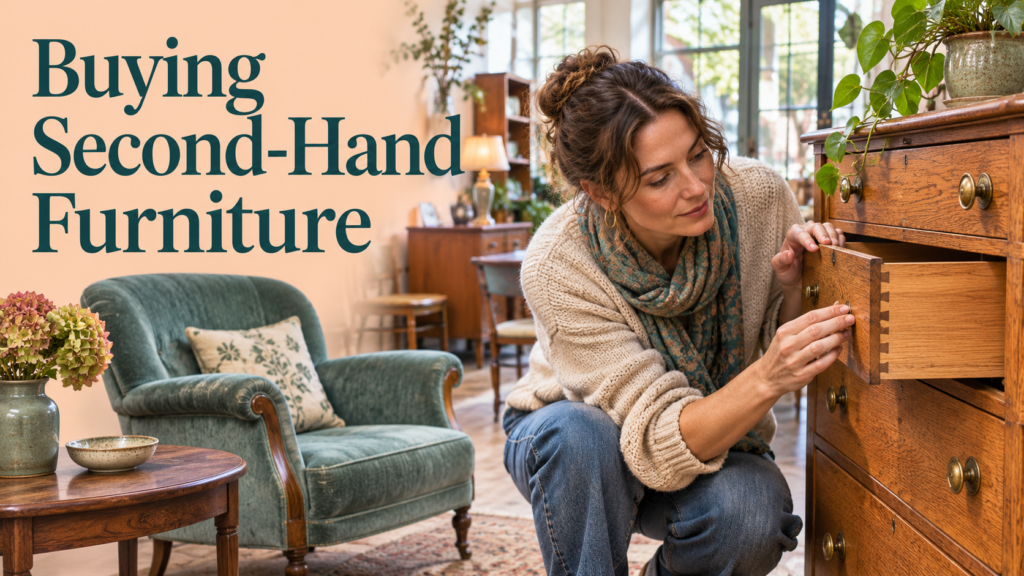
Buying second-hand furniture is one of the smartest ways to furnish a home in the UK. It saves money, keeps usable furniture out of landfill and often gets you better-made pieces than new budget furniture at the same price. Solid oak tables, vintage teak sideboards, Victorian chests of drawers and well-built sofas regularly sell for a fraction of their original cost.
Second-hand buying comes with risks too: hidden damage, woodworm, bed bugs, missing fire labels, scams and limited consumer rights when buying privately. This guide covers where to buy second-hand furniture, what’s worth buying, how to inspect it, fire safety labels, your legal rights, pricing and negotiating, collection and delivery, cleaning and restoration, and the mistakes to avoid.
Table of Contents
Why Buy Second-Hand Furniture?
| Benefit | Why It Matters |
|---|---|
| Lower cost | Often a fraction of the new price |
| Better quality | Older pieces are often solid wood with traditional joinery |
| Sustainability | Keeps furniture out of landfill |
| Character | Unique pieces with history |
| Investment potential | Some designer and vintage pieces hold value |
| Immediate availability | No long delivery waits |
| Supports charities | When buying from charity shops |
The Waste Problem
UK households throw away huge amounts of furniture. Research by Mattress Online found that an average of 22 million pieces of furniture are discarded per year in the UK, much of which goes straight to landfill. An RSA study for Suez found that only 15% of UK furniture is reused or recycled, while half of the 1.6 million tonnes sent to landfill could be.
Buying second-hand helps reduce this. Real Homes notes that sourcing it second-hand, as opposed to opting for a brand new model will cut down on someone else’s waste.
Where to Buy Second-Hand Furniture in the UK
| Source | Pros | Cons |
|---|---|---|
| Charity shops and furniture charities | Affordable, supports good causes, safety-checked upholstery | Stock varies |
| Furniture reuse charities | Low prices, delivery often available | Limited choice |
| Online marketplaces | Huge choice, local collection | Mixed quality, scam risk |
| Auction houses | Bargains, quality antiques | Buyer’s premium, sold as seen |
| Online auctions | Convenient, wide choice | Can’t always inspect in person |
| Vintage and antique dealers | Curated, often restored, trader rights | Higher prices |
| Antique centres and fairs | Browse many sellers at once | Need to negotiate |
| Reclamation yards | Doors, fireplaces, architectural pieces | Heavy items, need restoration |
| House clearances | Bargains, whole-house contents | Variable condition |
| Ex-office furniture suppliers | Quality desks and chairs | Office styling |
| Car boot sales | Cheap finds | No legal protection |
| Freecycle and free groups | Free items | First come, first served |
What’s Worth Buying Second-Hand?
Great Second-Hand Buys
| Item | Why |
|---|---|
| Solid wood tables | Durable, easy to refinish |
| Chests of drawers | Often well made with dovetail joints |
| Sideboards and dressers | Lots of storage and character |
| Wardrobes | Much cheaper than new solid wood |
| Bookcases and shelving | Simple, long-lasting |
| Dining chairs | Can be reupholstered |
| Mid-century furniture | Stylish and often affordable |
| Antique furniture | Often cheaper than new quality furniture |
| Mirrors and lighting | Easy to update |
| Office desks and chairs | High-quality ex-office pieces |
| Garden furniture | Metal and hardwood pieces last well |
| Bed frames (wooden or metal) | Easy to clean and inspect |
Items to Be Cautious With
| Item | Why |
|---|---|
| Mattresses | Hygiene, bed bugs, worn support |
| Upholstered furniture without fire labels | Fire safety and legal issues |
| Cheap flat-pack furniture | Often damaged by moving and reassembly |
| Baby and children’s products | Must meet current safety standards |
| Cots and car seats | Safety standards and unknown history |
| Furniture with damp or mould | Can spread in your home |
| Electrical recliners | Need safety checks |
Brands to Look Out For
Quality British makers turn up regularly in second-hand markets. Homes & Antiques notes that for under £500, you can pick up designs by great British makers such as G-Plan, Ercol, Stag, Hille and Archie Shine, which are not only timelessly stylish, but also highly collectable.
Other names worth recognising include McIntosh, Nathan, Parker Knoll, Old Charm and Younger, along with antique pieces from Victorian and Edwardian makers.
Fire Safety Labels on Upholstered Furniture
Fire safety is one of the most important checks when buying second-hand upholstered furniture.
What the Law Says
The Furniture and Furnishings (Fire) (Safety) Regulations 1988 apply to new and second-hand furniture. Pembrokeshire Trading Standards explains that under the Furniture and Furnishings (Fire) (Safety) Regulations 1988, used furniture must meet the same stringent standards as new furniture on sale in the shops.
The rules cover a wide range of items. Regulations cover the flammability of upholstered furniture (including beds, sofa beds, cots, cushions and mattresses).
Who Must Comply
The regulations apply to businesses and traders, including persons who supply second-hand furniture in the course of business or trade, including auctioneers and some charities and charities selling furniture as part of their business.
This is why charity shops ask about labels. The Reuse Network explains that charities would be breaking the law if they collected it from you and sold the item to another person without the assurance it is safe.
Checking the Label
Compliant upholstered furniture should carry a permanent label. Business Companion notes that new upholstered furniture must carry a permanent label with the heading ‘CARELESSNESS CAUSES FIRE’. This label is usually found behind a loose cover at the rear, or under the seat cushions or base.
Reupholstered Furniture
Reupholstered furniture must also comply. Causeway Coast and Glens Council notes that upholstered furniture that has been reupholstered or refilled since 1988 must meet fully the current legal requirements regardless of when the furniture was originally made. It is an offence to supply such furniture without a permanent label.
Recent Changes
The regulations were updated recently. Business Companion notes the Furniture and Furnishings (Fire) (Safety) Regulations 1988 were amended in October 2025 to remove certain baby products from their scope, which must instead meet general product safety rules.
Fire Label Tips
- Always check for the permanent label on sofas, armchairs, sofa beds and upholstered headboards
- Be cautious buying unlabelled upholstered items, even from private sellers
- Keep labels attached on your own furniture so it can be resold or donated
- Antique furniture made before 1950 is generally exempt, but check if it has been reupholstered since
Your Consumer Rights
Trader vs Private Seller
Your rights depend mainly on who you buy from. Saga explains that when it comes to shoppers’ rights, the most important distinction is not whether an item is new or second-hand – it is whether it’s being sold by a business or a private seller.
| Seller Type | Your Rights |
|---|---|
| Trader (dealer, shop, online business, some charity shops) | Goods must be of satisfactory quality, as described and fit for purpose |
| Private individual | Goods must only match their description |
| Auctions | Often limited; check auction terms |
| Car boot sales and informal sales | Very limited protection |
Buying From a Trader
When you buy from a business, the Consumer Rights Act 2015 applies. One legal guide summarises it: When you buy second-hand goods from a business — a dealer, charity shop, pawnbroker, or online reseller — the Consumer Rights Act 2015 applies in full.
Bromley Council’s trading standards guidance confirms that if you sell something, whether new or second-hand, it must be of satisfactory quality, as described and fit for its purpose.
You also have a short-term right to reject. One guide notes if the second‑hand item is faulty, not as described, or unfit for use, you can reject it and demand a full refund within 30 days of delivery.
Faults Pointed Out at Sale
You can’t usually reject a second-hand item for a fault you were told about. ARAG’s legal guide notes that second-hand items cannot be returned for a fault pointed out at the time of purchase. Anything which subsequently develops as a fault may mean the goods can be returned.
Buying From a Private Seller
Private sales carry much less protection. Saga explains that if you buy from a private seller, you won’t get the same rights as you would from a business. Under the Consumer Rights Act, a private seller is only obliged to provide goods “as described”.
Private sellers don’t have to point out problems. Which? warns buyer beware if you’re buying from a private seller – they don’t have to draw attention to defects.
Buying Online
If you buy second-hand online from a trader, you get extra protection. Which? notes second-hand goods bought from online retailers are covered by the Consumer Contracts Regulations. This generally gives you a 14-day cancellation period for distance purchases.
Online marketplaces should show whether a seller is a business. One legal guide notes that the platform must clearly indicate whether the seller is a business or a private seller. You get full consumer rights only where the seller is a business.
Consumer Rights Summary
| Situation | Protection |
|---|---|
| Trader, in person | Consumer Rights Act 2015 |
| Trader, online | Consumer Rights Act plus Consumer Contracts Regulations |
| Private seller | Goods must be as described |
| Auction | Check terms; often limited |
| Fault pointed out at sale | Can’t usually reject for that fault |
How to Inspect Second-Hand Furniture
General Checklist
| Check | What to Look For |
|---|---|
| Stability | Wobbles, loose legs, uneven feet |
| Joints | Cracks, gaps, loose dowels |
| Drawers | Smooth running, intact runners and bases |
| Doors | Hinges, alignment, catches |
| Surfaces | Scratches, burns, water rings, veneer damage |
| Smell | Damp, smoke, pets, mould |
| Pests | Woodworm holes, bed bug signs |
| Measurements | Will it fit through doors and stairs? |
| Materials | Solid wood vs veneer vs chipboard |
Checking Wooden Furniture
- Solid wood: look at end grain and edges; patterns continue through the wood
- Veneer: thin layer over another material; check for lifting edges
- Dovetail joints: sign of good quality in drawers
- Woodworm: small round holes and fresh powdery dust (frass) suggest active infestation
- Water damage: warped panels, swollen chipboard, dark stains
- Weight: solid hardwood furniture is usually heavy
Checking Upholstered Furniture
- Check for the fire safety label
- Press seats and cushions to check support
- Look for sagging springs or webbing
- Check for tears, stains and worn arms
- Lift cushions and check seams for bed bugs
- Smell for smoke, damp and pets
- Check frames for creaking or loose joints
- Check removable covers and zips
Spotting Bed Bugs
Check seams, folds, buttons and crevices for:
- Small reddish-brown insects
- Tiny dark spots (droppings)
- Shed skins
- Small blood stains
- A sweet, musty smell
If in doubt, walk away. Bed bugs are expensive and difficult to eliminate.
Checking Metal and Garden Furniture
- Rust and corrosion
- Broken welds
- Wobbly frames
- Cracked or missing slats
Pricing and Negotiating
How to Judge Value
- Compare prices for similar items online
- Check sold prices, not just asking prices
- Factor in condition and restoration costs
- Consider collection and delivery costs
- Look up brand names and model numbers
Example Vintage Prices
Vintage British furniture is often good value. Example dealer prices include:
| Item | Example Price |
|---|---|
| G-Plan Danish chest of drawers | Around £450 |
| G-Plan Tola dining table | £375 |
| Danish teak tallboy | £375 |
| Ib Kofod-Larsen G-Plan sideboard | £915 |
Homes & Antiques says a G-Plan Danish chest of drawers costs around £450 from Orange & Brown. Hunt Vintage has listed a Mid Century G Plan Tola Dining Table£375 and a Mid Century Danish Teak Tallboy Chest Of Drawers£375, while Vinterior listed a Mid Century Teak Sideboard By Ib Kofod Larsen For G Plan / E Gomme, 1960s at £915 per item. Unbranded pieces and items needing work are usually much cheaper.
Negotiating Tips
- Be polite and realistic
- Point out genuine faults
- Offer cash for a quick sale
- Offer to collect quickly
- Bundle several items for a better price
- Shop at the end of the day at markets and fairs
- Ask dealers if they offer discounts on items in stock a long time
Staying Safe When Buying Privately
Avoid Scams
| Red Flag | What to Do |
|---|---|
| Price too good to be true | Be suspicious |
| Seller won’t let you view | Don’t pay in advance |
| Pressure to pay a deposit by bank transfer | Avoid unless you trust the seller |
| Seller asks to move off the platform | Stay on the platform’s messaging |
| Photos look like stock images | Ask for extra photos |
| Courier “arranged by the seller” with upfront payment | Common scam; be careful |
Payment Tips
- Pay on collection after inspecting the item
- Use platforms with buyer protection where available
- Card payments give more protection than cash or bank transfer
- Get a receipt or written description
Personal Safety
- Take someone with you when collecting
- Meet in daylight
- Tell someone where you’re going
- Don’t share more personal information than necessary
Collection and Delivery
Large items can be tricky to move.
Before You Buy
- Measure doorways, stairs, hallways and lifts
- Measure the item, including depth and height
- Check whether items can be dismantled
- Check parking at both locations
Delivery Options
| Option | Pros | Cons |
|---|---|---|
| Collect yourself | Cheapest | Need a suitable vehicle and helpers |
| Hire a van | Flexible | Cost and driving |
| Man-and-van service | Help with lifting | Adds to cost |
| Courier platforms | Convenient for long distances | Damage risk; check insurance |
| Dealer delivery | Professional handling | Usually higher cost |
Tip: wrap furniture in blankets and use straps. Take photos before collection in case of damage.
Cleaning and Restoring Second-Hand Furniture
Wooden Furniture
- Clean with a damp cloth and mild soap
- Remove old wax with a suitable cleaner
- Treat scratches with wax filler sticks or touch-up pens
- Remove water rings carefully
- Re-oil teak and oiled furniture
- Wax or polish other finishes
- Tighten screws and re-glue loose joints
Upholstered Furniture
- Vacuum thoroughly, including seams
- Steam clean where suitable
- Wash removable covers according to labels
- Use professional upholstery cleaning for heavy stains
- Consider reupholstery for worn pieces
Painting and Upcycling
- Sand and prime before painting
- Use furniture paint or low-VOC paint
- Replace handles and knobs
- Add new legs to sofas and chests
- Line drawers with wallpaper
Dealing With Woodworm
- Isolate infested items
- Treat with a suitable woodworm treatment
- Check for fresh dust over time
- Get professional advice for valuable antiques
Reupholstery Costs
Reupholstery can be expensive and often costs more than the furniture itself. Typical approximate costs:
| Item | Approximate Cost |
|---|---|
| Dining chair seat pad | £40–£120 |
| Armchair | £300–£900+ |
| Two-seater sofa | £600–£1,500+ |
| Three-seater sofa | £800–£2,000+ |
These are rough ranges; prices depend heavily on fabric, labour and the condition of springs and frames. Get quotes before buying a piece you plan to reupholster.
Selling or Donating Your Old Furniture
Buying second-hand often means getting rid of old pieces too:
- Sell on online marketplaces
- Donate to charity shops or furniture reuse charities
- Offer for free locally
- Use council bulky waste collections as a last resort
Keep fire labels on upholstered furniture. The Reuse Network warns that without the label, you will not be able to donate your item to charity.
Second-Hand Furniture Buying Checklist
- Measure your space and access routes
- Decide your budget, including delivery and restoration
- Research prices for similar items
- Check whether the seller is a trader or private seller
- Ask for photos, measurements and condition details
- Inspect in person where possible
- Check for fire labels on upholstered items
- Check for woodworm, bed bugs, damp and smells
- Negotiate politely
- Pay safely and get a receipt
- Plan collection or delivery
- Clean and inspect again before bringing into your home
Common Mistakes
| Mistake | Better Approach |
|---|---|
| Not measuring access | Measure doors, stairs and lifts |
| Buying upholstered items without fire labels | Check labels first |
| Ignoring bed bug signs | Inspect seams and crevices |
| Assuming full rights from private sellers | Know the difference between traders and individuals |
| Paying in advance to unknown sellers | Pay on collection |
| Buying flat-pack furniture that won’t survive reassembly | Choose solid, well-made pieces |
| Underestimating restoration costs | Get reupholstery quotes first |
| Bringing damp or mouldy furniture home | Walk away |
| Forgetting collection costs | Budget for transport |
| Impulse buying | Check it fits your space and style |
Final Thoughts
Buying second-hand furniture saves money, reduces waste and often gets you higher-quality, more characterful pieces than new budget furniture. Charity shops, reuse charities, auctions, vintage dealers and online marketplaces all offer great finds, especially solid wood tables, chests, sideboards, wardrobes and mid-century pieces by brands like G-Plan and Ercol. Check items carefully for damage, woodworm and bed bugs, and look for permanent fire safety labels on upholstered furniture. Remember that buying from a trader gives you full Consumer Rights Act protection, while private sellers only have to supply goods as described. Measure your space, pay safely, plan collection and budget for any cleaning or restoration.
Frequently Asked Questions
1. Is it safe to buy second-hand sofas?
Yes, if they have a permanent fire safety label and show no signs of bed bugs, damp or structural damage.
2. What are my rights when buying second-hand furniture?
From a trader, goods must be of satisfactory quality, as described and fit for purpose. From a private seller, they only need to match their description.
3. Where is the best place to buy second-hand furniture in the UK?
Charity shops, furniture reuse charities, auctions, vintage dealers and online marketplaces are all good places to find quality second-hand furniture.